
Tesamorelin
Tesamorelin: Research Compound Overview
Tesamorelin is a synthetic 44-residue peptide that reproduces the full amino-acid sequence of human growth hormone-releasing hormone (GHRH 1-44, C-terminal amide) with a trans-3-hexenoyl group attached to the N-terminal tyrosine. The N-terminal acyl modification was introduced to increase stability against aminopeptidase cleavage in plasma, and the compound is classed in the literature as a GHRH analog (also designated TH9507).
| CAS number | 218949-48-5 |
|---|---|
| Molecular formula | C221H366N72O67S |
| Molecular weight | 5135.9 g/mol |
| Sequence | (trans-3-hexenoyl)-YADAIFTNSYRKVLGQLSARKLLQDIMSRQQGESNQERGARARL-NH2 |
| Storage | Store lyophilized at -20 °C, desiccated, protected from light. |
Chemical identity & structure
Tesamorelin is the N-acylated form of the 44-amino-acid human growth hormone-releasing hormone. The peptide backbone is identical to native hGHRH(1-44)-NH2:
(trans-3-hexenoyl)-YADAIFTNSYRKVLGQLSARKLLQDIMSRQQGESNQERGARARL-NH2
- CAS number: 218949-48-5 (free base); 901758-09-6 (acetate salt)
- Molecular formula: C221H366N72O67S (free base)
- Molecular weight: approximately 5135.9 g/mol
- Length: 44 amino acids, linear, C-terminal amide
- Registry identifiers: PubChem CID 16137828; FDA UNII MQG94M5EEO (free base) and LGW5H38VE3 (acetate); KEGG D09015 (acetate)
- Development code: TH9507
The defining structural feature is the trans-3-hexenoyl (C6H9O) group amide-linked to the alpha-amine of Tyr1. This adds C6H8O to the native hGHRH(1-44) amide, which accounts for the difference between the native peptide formula and that of tesamorelin. The sequence contains a single methionine (Met27), two aspartates, two glutamates and a cluster of arginine and lysine residues, giving the molecule a net positive charge at neutral pH. Met27 is the principal oxidation-sensitive site, and methionine sulfoxide (+16 Da) is a common related impurity that mass spectrometry can distinguish from the intact peptide.
Some secondary databases list differing formulas for tesamorelin; the formula above is consistent with the native hGHRH(1-44)-NH2 backbone plus the hexenoyl group and matches the values listed by KEGG and PubChem-derived records. Research material is produced by solid-phase peptide synthesis, with the hexenoyl group coupled at the N-terminus before cleavage and purification. Commercial material is usually supplied as an acetate salt.
Mechanisms studied in the literature
Tesamorelin has been studied as an agonist of the growth hormone-releasing hormone receptor (GHRHR), a class B G protein-coupled receptor expressed on somatotroph cells of the anterior pituitary. Binding of GHRH-family peptides to GHRHR is coupled to Gs, adenylyl cyclase activation and cAMP accumulation, the signalling pathway that researchers use to characterize GHRH analogs in pituitary cell and receptor-expressing cell models.
A recurring theme in this literature is plasma stability. Frohman and colleagues (1986) showed with HPLC, radioimmunoassay and bioassay that native GHRH(1-44)-NH2 is rapidly cleaved in plasma by a dipeptidylaminopeptidase that removes the N-terminal Tyr-Ala dipeptide, generating GHRH(3-44)-NH2, a fragment with less than one-thousandth of the parent biological activity. The N-terminal hexenoyl group of tesamorelin was designed to block this cleavage site.
Non-clinical characterization of TH9507 was reported by Ferdinandi and co-workers (2007). Their work described reduced susceptibility to dipeptidyl peptidase-IV (DPP-IV) degradation and slower degradation in plasma compared with the native sequence, and examined circulating growth hormone and IGF-1 in pig, rat and dog models. The same report presented toxicology findings in rats and dogs, which the authors attributed to sustained exposure to elevated GH and IGF-1 concentrations. These studies are frequently cited as the reference preclinical pharmacology for the molecule.
Areas of published research
Published work on tesamorelin falls into several research areas:
- Neuroendocrinology and the GH/IGF-1 axis: characterization of GHRH receptor agonism and of the downstream growth hormone and IGF-1 axis in animal models.
- Peptide stability and analog design: tesamorelin is a frequently cited example of N-terminal modification used to protect a peptide hormone from DPP-IV-type cleavage, alongside D-amino-acid substitution strategies used in other GHRH analogs.
- Metabolic and endocrine research: tesamorelin has been investigated in clinical research, including randomized, placebo-controlled studies in metabolic and endocrine settings (for example Falutz et al., 2010, and Clemmons et al., 2017).
- Comparative pharmacology: the compound is often studied alongside other GHRH-receptor ligands, such as sermorelin and modified GRF(1-29) analogs, to compare stability, receptor activation and duration of signalling.
These are descriptions of research fields in which the molecule appears, not statements of any outcome. Researchers should consult the primary literature for study designs, models and limitations.
Handling, reconstitution chemistry & storage
Lyophilized peptide powders are hygroscopic. Vials should be allowed to reach room temperature in a desiccator before opening, so that atmospheric moisture does not condense on the cold powder, and should be resealed promptly. Long-term storage of the lyophilized material at -20 °C or below, desiccated and protected from light, is the standard laboratory practice for preserving integrity; short excursions to ambient temperature during shipping are generally tolerated by dry peptide powders.
Tesamorelin is a relatively large, basic peptide. Its arginine and lysine content generally supports solubility in water or dilute aqueous acid, while the N-terminal hexenoyl group adds some hydrophobic character. Sterile water or a dilute acetic acid solution are common starting solvents for preparing a concentrated stock; gentle swirling rather than vigorous shaking limits foaming and aggregation at the air-liquid interface.
Two degradation routes are relevant to laboratory handling. Met27 can oxidize to methionine sulfoxide in solution, particularly in the presence of dissolved oxygen, light or trace metals, and asparagine residues (Asn8, Asn35) can undergo deamidation, which is accelerated at neutral to alkaline pH and elevated temperature. Preparing stocks in degassed solvent, protecting them from light and dividing them into single-use aliquots stored frozen limits both processes and avoids repeated freeze-thaw. Aliquots should be thawed once and kept cold during use.
Quality documentation
Every CheatCodes lot of tesamorelin is analyzed by reverse-phase HPLC for chromatographic purity and by mass spectrometry for identity confirmation, with the observed mass compared against the theoretical value for the expected sequence. The findings of that analysis are recorded on a lot-specific certificate of analysis (COA), which is published in the CheatCodes COA library and can be matched to the lot number printed on each vial.
Lot traceability matters for reproducibility. Synthetic peptides can differ between batches in purity, counter-ion content (for example acetate or trifluoroacetate), water content and the profile of minor related impurities such as deletion, truncated or racemized sequences. For tesamorelin specifically, MS confirms both the intact 44-residue backbone and the presence of the N-terminal hexenoyl group, and it can detect the +16 Da methionine sulfoxide variant that HPLC alone may not fully resolve. Recording the lot number alongside experimental data allows a laboratory to compare runs across material batches, to investigate unexpected variation, and to report the analytical characterization of the material in methods sections.
A certificate of analysis for a synthetic peptide generally identifies the compound name, lot number and test date, reports HPLC purity as a percentage of total peak area, and records the mass observed by MS against the expected value. Reviewing these fields before an experiment confirms that the material on the bench matches the material described in the laboratory record. Researchers are encouraged to retain the COA with their laboratory records and to use net peptide content, rather than gross powder weight, when preparing stock solutions.
Frequently asked questions
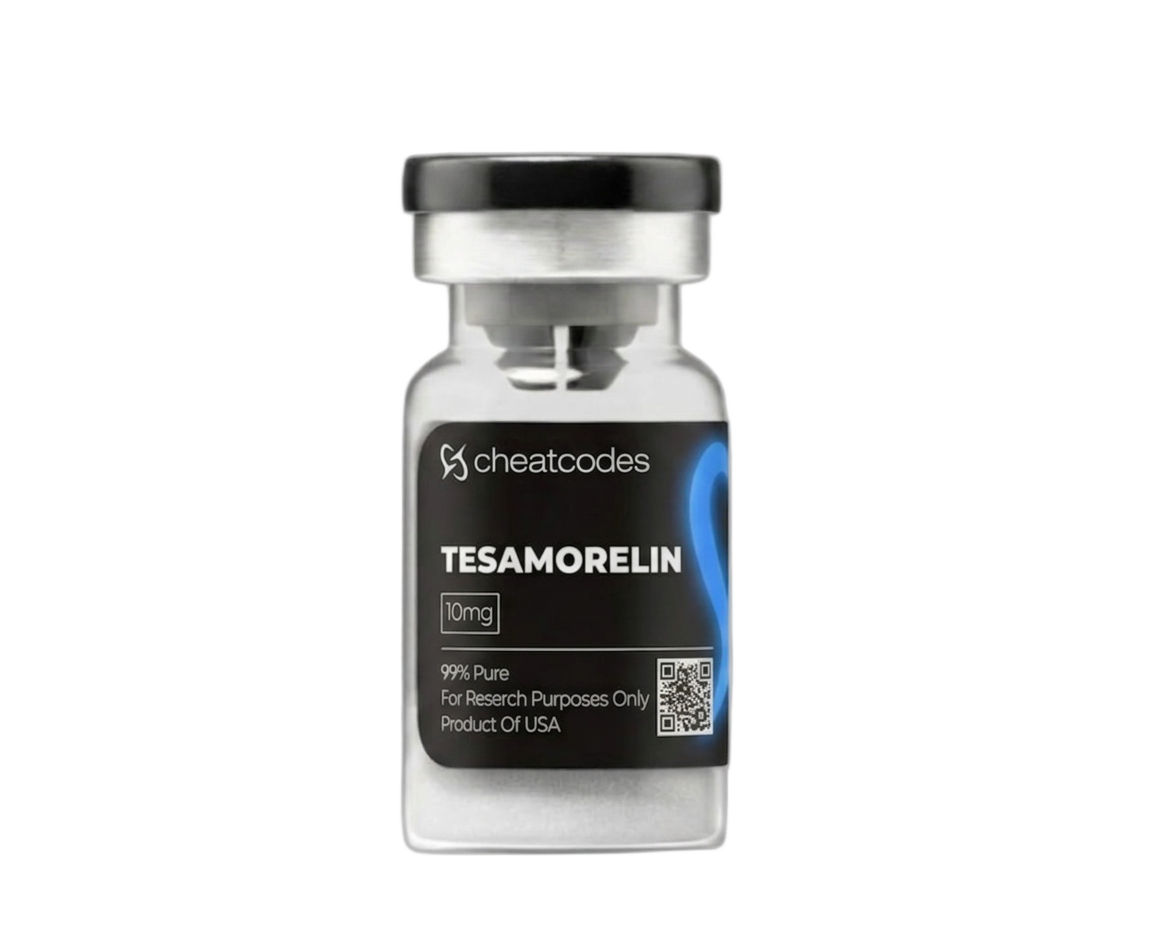
Research-grade Tesamorelin in stock
Tesamorelin · $44.99 – $89.99
All products are supplied for laboratory research use only. They are not intended for human or animal consumption, and have not been evaluated by the FDA for the diagnosis, treatment, cure, or prevention of any disease.
References
- Rapid enzymatic degradation of growth hormone-releasing hormone by plasma in vitro and in vivo to a biologically inactive product cleaved at the NH2 terminus. Journal of Clinical Investigation (1986).
- Non-clinical pharmacology and safety evaluation of TH9507, a human growth hormone-releasing factor analogue. Basic & Clinical Pharmacology & Toxicology (2007).
- Effects of tesamorelin, a growth hormone-releasing factor, in HIV-infected patients with abdominal fat accumulation: a randomized placebo-controlled trial with a safety extension. Journal of Acquired Immune Deficiency Syndromes (2010).
- Safety and metabolic effects of tesamorelin, a growth hormone-releasing factor analogue, in patients with type 2 diabetes: A randomized, placebo-controlled trial. PLoS One (2017).