
TB-500
TB-500: Research Compound Overview
TB-500 is a synthetic N-acetylated heptapeptide, Ac-LKKTETQ, corresponding to residues 17–23 of thymosin beta-4 (Tβ4), a 43-residue actin-sequestering protein. This short sequence lies within the central actin-binding region of Tβ4 and was identified as the principal component of products sold under the TB-500 name.
| CAS number | 885340-08-9 |
|---|---|
| Molecular formula | C38H68N10O14 |
| Molecular weight | 889.0 g/mol |
| Sequence | Ac-LKKTETQ-OH (Ac-Leu-Lys-Lys-Thr-Glu-Thr-Gln); thymosin beta-4 residues 17–23, N-acetylated |
| Storage | Store lyophilized at -20 °C, desiccated, protected from light. |
Chemical identity & structure
TB-500 is the N-terminally acetylated heptapeptide Ac-LKKTETQ-OH (Ac-Leu-Lys-Lys-Thr-Glu-Thr-Gln).
- CAS number: 885340-08-9
- Molecular formula: C38H68N10O14
- Molecular weight: approximately 889.0 g/mol
- Length: 7 amino acids, N-terminal acetyl cap, free C-terminal acid
The parent protein, thymosin beta-4, is a 43-amino-acid polypeptide that binds monomeric G-actin. Residues 17–23 (LKKTETQ) form part of its central actin-binding motif. Esposito et al. (Drug Testing and Analysis, 2012) identified this acetylated fragment in a commercial TB-500 product by HPLC with high-resolution mass spectrometry and confirmed the structure by solid-phase synthesis of a reference standard.
Note on nomenclature: the TB-500 name has at times been applied loosely to synthetic full-length Tβ4 in commercial settings. The identifiers on this page refer to the acetylated 17–23 fragment. The sequence contains two lysines, one glutamate and three hydroxyl- or amide-bearing residues (Thr, Thr, Gln), making it highly polar, and it has no cysteine, methionine or tryptophan residues.
Mechanisms studied in the literature
Research interest in TB-500 derives from the biology of thymosin beta-4. Tβ4 is one of the main G-actin-sequestering proteins in eukaryotic cells and regulates the pool of unpolymerized actin available for filament assembly. Van Troys et al. (The EMBO Journal, 1996) mapped the actin-binding site of Tβ4 by mutational analysis, identifying the central LKKTET region as essential for actin interaction. Later structural and biochemical work, summarized by Ying et al. (Current Protein & Peptide Science, 2023), describes the binding modes of Tβ4 with actin and how they relate to cytoskeletal dynamics and cell migration.
Studies of the 17–23 fragment itself have examined whether this short motif retains activity associated with the full-length protein in cell migration and wound-closure assays in vitro, and how the acetylated peptide is metabolized. Ho et al. (Journal of Chromatography A, 2012) developed liquid chromatography–mass spectrometry methods for TB-500 and its metabolites in equine urine and plasma.
Areas of published research
Published research relevant to TB-500 falls into several areas:
- Cytoskeletal biology: actin sequestration, actin polymerization dynamics and the structural basis of Tβ4–actin binding.
- Cell migration research: in-vitro scratch and migration assays comparing the fragment with full-length Tβ4.
- Tissue repair biology: preclinical models in which the parent protein Tβ4 has been studied in dermal, corneal and cardiac tissue.
- Analytical and anti-doping chemistry: LC–MS detection of TB-500 and its metabolites in equine and human matrices, and characterization of commercial products.
Full-length thymosin beta-4 has been investigated in clinical research; the 17–23 fragment sold as TB-500 has not, and it is listed on the World Anti-Doping Agency prohibited list. CheatCodes supplies TB-500 strictly as a research-use-only reference material.
Experimental designs frequently pair the fragment with full-length Tβ4 or with scrambled-sequence control peptides to separate sequence-specific activity from nonspecific peptide effects, and analytical studies use synthetic Ac-LKKTETQ as a reference standard for metabolite identification.
Handling, reconstitution chemistry & storage
TB-500 is supplied as a lyophilized (freeze-dried) powder. In the dry state, peptides of this kind are generally most stable when kept at -20 °C or below, sealed, desiccated and protected from light. Vials should be allowed to reach room temperature before opening so that atmospheric moisture does not condense on the powder, since absorbed water can accelerate hydrolysis and aggregation.
As a short and highly polar peptide, Ac-LKKTETQ is generally readily soluble in water and aqueous buffers. The N-terminal acetyl group blocks aminopeptidase cleavage at the N-terminus, but the C-terminal region remains susceptible to carboxypeptidase activity in biological matrices. The glutamine at the C-terminus can undergo slow deamidation in solution, so freshly prepared solutions are preferred for analytical work.
Once in solution, peptides are considerably less stable than in lyophilized form. Common laboratory practice is to prepare a concentrated stock in a suitable sterile solvent, divide it into single-use aliquots, and store the aliquots frozen to avoid repeated freeze–thaw exposure. Solutions should be protected from light and from microbial contamination, and buffer pH should be selected with the peptide's isoelectric behaviour and the downstream assay in mind.
Before use in quantitative work, researchers commonly verify concentration independently, for example by UV absorbance where aromatic residues are present or by amino-acid analysis, because lyophilized peptide powders contain variable amounts of counter-ion and residual water. Glass or low-binding polypropylene vials help reduce adsorptive losses at low concentrations.
Quality documentation
Every CheatCodes lot of TB-500 is analyzed by reverse-phase HPLC for chromatographic purity and by mass spectrometry for identity confirmation, with the observed mass compared against the theoretical value for the expected sequence. The findings of that analysis are recorded on a lot-specific certificate of analysis (COA), which is published in the CheatCodes COA library and can be matched to the lot number printed on each vial.
Lot traceability matters for reproducibility. Synthetic peptides can differ between batches in purity, counter-ion content (for example acetate or trifluoroacetate), water content and the profile of minor related impurities such as deletion or truncated sequences. Recording the lot number alongside experimental data allows a laboratory to compare runs across material batches, to investigate unexpected variation, and to report the analytical characterization of the material in methods sections. Researchers are encouraged to retain the COA with their laboratory records and to confirm that net peptide content, rather than gross powder weight, is used when preparing stock solutions.
A certificate of analysis for a synthetic peptide generally identifies the compound name, lot number and test date, reports HPLC purity as a percentage of total peak area, and records the mass observed by MS against the expected value. Reviewing these fields before an experiment confirms that the material on the bench matches the material described in the laboratory record.
Frequently asked questions
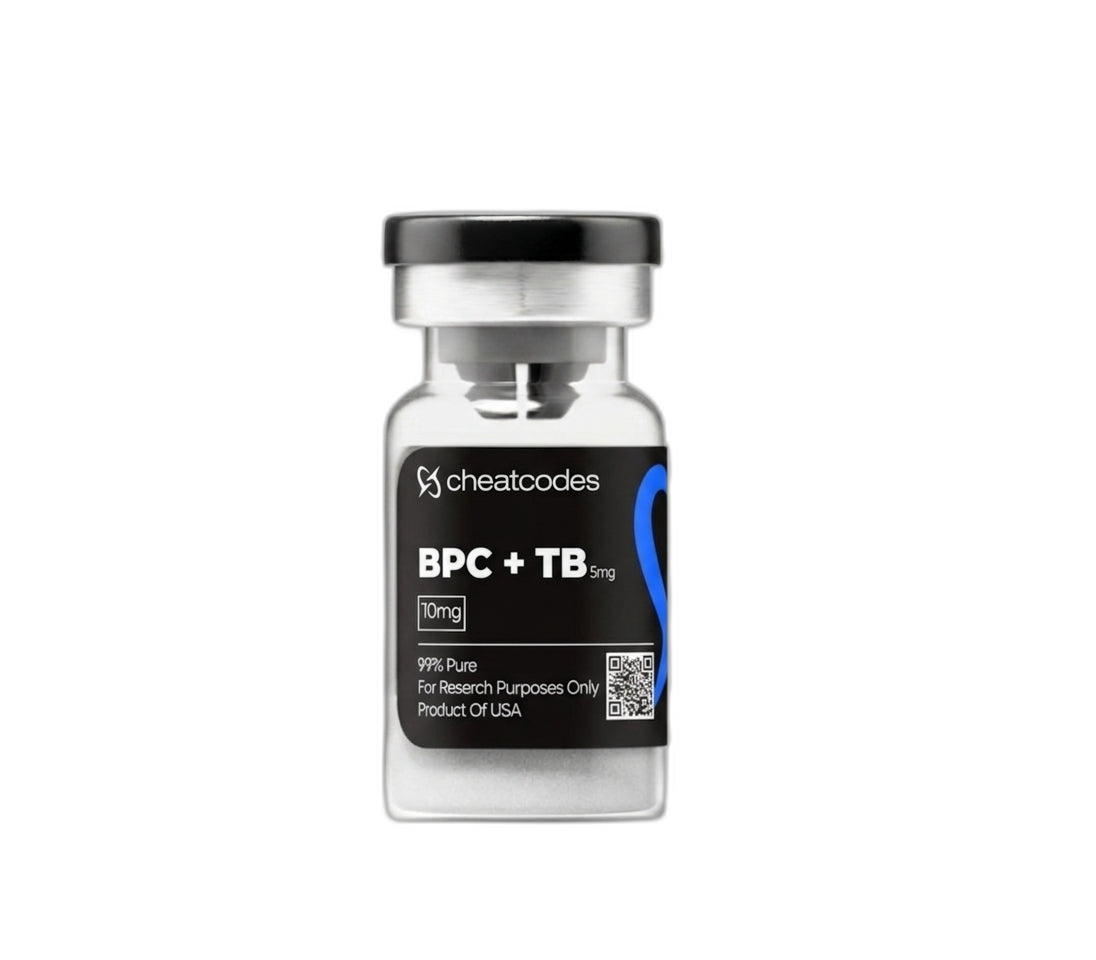
Research-grade TB-500 in stock
BPC + TB500 Blend · $44.99
All products are supplied for laboratory research use only. They are not intended for human or animal consumption, and have not been evaluated by the FDA for the diagnosis, treatment, cure, or prevention of any disease.
References
- The actin binding site of thymosin beta 4 mapped by mutational analysis. The EMBO Journal (1996).
- Synthesis and characterization of the N-terminal acetylated 17-23 fragment of thymosin beta 4 identified in TB-500, a product suspected to possess doping potential. Drug Testing and Analysis (2012).
- Doping control analysis of TB-500, a synthetic version of an active region of thymosin β4, in equine urine and plasma by liquid chromatography–mass spectrometry. Journal of Chromatography A (2012).
- Thymosin β4 and Actin: Binding Modes, Biological Functions and Clinical Applications. Current Protein & Peptide Science (2023).