
Semax
Semax: Research Compound Overview
Semax is a synthetic heptapeptide (Met-Glu-His-Phe-Pro-Gly-Pro) derived from the adrenocorticotropic hormone fragment ACTH(4-7), extended with a C-terminal Pro-Gly-Pro motif for metabolic stability. It is described in the literature as an ACTH(4-10) analog and was developed at the Institute of Molecular Genetics of the Russian Academy of Sciences.
| CAS number | 80714-61-0 |
|---|---|
| Molecular formula | C37H51N9O10S |
| Molecular weight | 813.93 g/mol |
| Sequence | MEHFPGP (Met-Glu-His-Phe-Pro-Gly-Pro) |
| Storage | Store lyophilized at -20 °C, desiccated, protected from light. |
Chemical identity & structure
Semax is a linear seven-residue peptide with the sequence MEHFPGP (Met-Glu-His-Phe-Pro-Gly-Pro).
- CAS number: 80714-61-0 (free peptide)
- Molecular formula: C37H51N9O10S
- Molecular weight: approximately 813.93 g/mol
- Length: 7 amino acids
- Registry identifier: FDA UNII I5FAL2585H
The N-terminal tetrapeptide Met-Glu-His-Phe corresponds to residues 4–7 of adrenocorticotropic hormone (ACTH), a region that overlaps the His-Phe-Arg-Trp core shared by melanocortin peptides. The native ACTH(4-10) fragment was the starting point for the design; in Semax the C-terminal portion is replaced by Pro-Gly-Pro, a tripeptide that resists many peptidases and is itself studied as a regulatory fragment. Semax contains one acidic residue (Glu), one histidine and no basic Lys or Arg residues. It contains a single methionine, which is susceptible to oxidation to methionine sulfoxide, and one phenylalanine. Research material is produced by solid-phase peptide synthesis and is frequently supplied as an acetate salt.
Mechanisms studied in the literature
Mechanistic studies of Semax have focused on neurotrophin gene expression, monoaminergic systems and peptidase inhibition, largely in rodent models.
Neurotrophin transcription. Dmitrieva et al. (Cellular and Molecular Neurobiology, 2010) examined rats with permanent middle cerebral artery occlusion and measured cortical mRNA for neurotrophins and their receptors at several time points after exposure to Semax or to its Pro-Gly-Pro fragment. Both peptides altered transcription of these genes, with only partly overlapping patterns, and the Semax-associated changes were reported as specific to the ischemic cortex.
Monoaminergic systems. Eremin et al. (Neurochemical Research, 2005) measured striatal monoamines, including extracellular levels by microdialysis, and locomotor activity in rodents. Semax increased levels of the serotonin metabolite 5-HIAA in the striatum without altering dopamine or its metabolites on its own, and it modified the dopaminergic and locomotor response to d-amphetamine.
Enkephalinase inhibition. Kost et al. (Bioorganicheskaia Khimiia, 2001) reported that Semax and the related peptide Selank inhibited enkephalin-degrading enzymes in human serum in vitro in a concentration-dependent manner, with stronger inhibition than several reference peptidase inhibitors.
Areas of published research
Published research on Semax is concentrated in the following areas:
- Neurochemistry: regulation of brain-derived neurotrophic factor (BDNF), nerve growth factor (NGF) and their receptors in rodent brain regions and glial cell culture.
- Experimental cerebral ischemia: gene-expression studies in rodent models of focal and global ischemia.
- Neuropharmacology: interactions with dopaminergic and serotonergic systems, and rodent behavioural models of learning, attention and stress-related behaviour.
- Melanocortin peptide research: structure–activity relationships of ACTH-derived fragments that lack corticotropic activity.
- Peptide biochemistry: metabolic stabilization via the Pro-Gly-Pro motif and the activity of the Pro-Gly-Pro fragment itself.
Semax has been investigated in clinical research, mainly in Russia. CheatCodes supplies it strictly as a research-use-only reference material for laboratory investigation and not for any other purpose.
As with other peptides developed within a single research network, independent replication and clear reporting of peptide source, salt form and purity strengthen the literature. Well-characterized reference material supports this kind of reproducibility work.
Handling, reconstitution chemistry & storage
Semax is supplied as a lyophilized (freeze-dried) powder. In the dry state, peptides of this kind are generally most stable when kept at -20 °C or below, sealed, desiccated and protected from light. Vials should be allowed to reach room temperature before opening so that atmospheric moisture does not condense on the powder, since absorbed water can accelerate hydrolysis.
The N-terminal methionine is the main chemical liability. Methionine oxidizes to the sulfoxide on exposure to air, light, trace metals and peroxide contaminants in some solvents and detergents, producing a +16 Da species that is readily seen by mass spectrometry. Minimizing headspace, avoiding prolonged exposure of solutions to air, and using high-purity, peroxide-free solvents help limit this. The histidine residue can coordinate divalent metal ions such as copper and zinc, which is relevant when choosing buffers and assessing assay interference.
Semax is generally soluble in water and dilute aqueous buffers. Common laboratory practice is to prepare a concentrated stock in a suitable sterile solvent, divide it into single-use aliquots, and store the aliquots frozen to avoid repeated freeze–thaw exposure. Solutions should be protected from light.
Because Semax contains phenylalanine but no tryptophan or tyrosine, its absorbance at 280 nm is very low, so concentration is better confirmed from net peptide content on the COA, amino-acid analysis or far-UV absorbance. Glass or low-binding polypropylene vials help reduce adsorptive losses at low concentrations.
Quality documentation
Every CheatCodes lot of Semax is analyzed by reverse-phase HPLC for chromatographic purity and by mass spectrometry for identity confirmation, with the observed mass compared against the theoretical value for the expected sequence. The findings of that analysis are recorded on a lot-specific certificate of analysis (COA), which is published in the CheatCodes COA library and can be matched to the lot number printed on each vial.
Lot traceability matters for reproducibility. Synthetic peptides can differ between batches in purity, counter-ion content (for example acetate or trifluoroacetate), water content and the profile of minor related impurities such as deletion or truncated sequences. For a methionine-containing peptide such as Semax, the level of the oxidized (+16 Da) species is an additional quality attribute worth checking on the chromatogram and mass spectrum. Recording the lot number alongside experimental data allows a laboratory to compare runs across material batches, to investigate unexpected variation, and to report the analytical characterization of the material in methods sections. Researchers are encouraged to retain the COA with their laboratory records and to use net peptide content, rather than gross powder weight, when preparing stock solutions.
A certificate of analysis for a synthetic peptide generally identifies the compound name, lot number and test date, reports HPLC purity as a percentage of total peak area, and records the mass observed by MS against the expected value. Reviewing these fields before an experiment confirms that the material on the bench matches the material described in the laboratory record.
Frequently asked questions
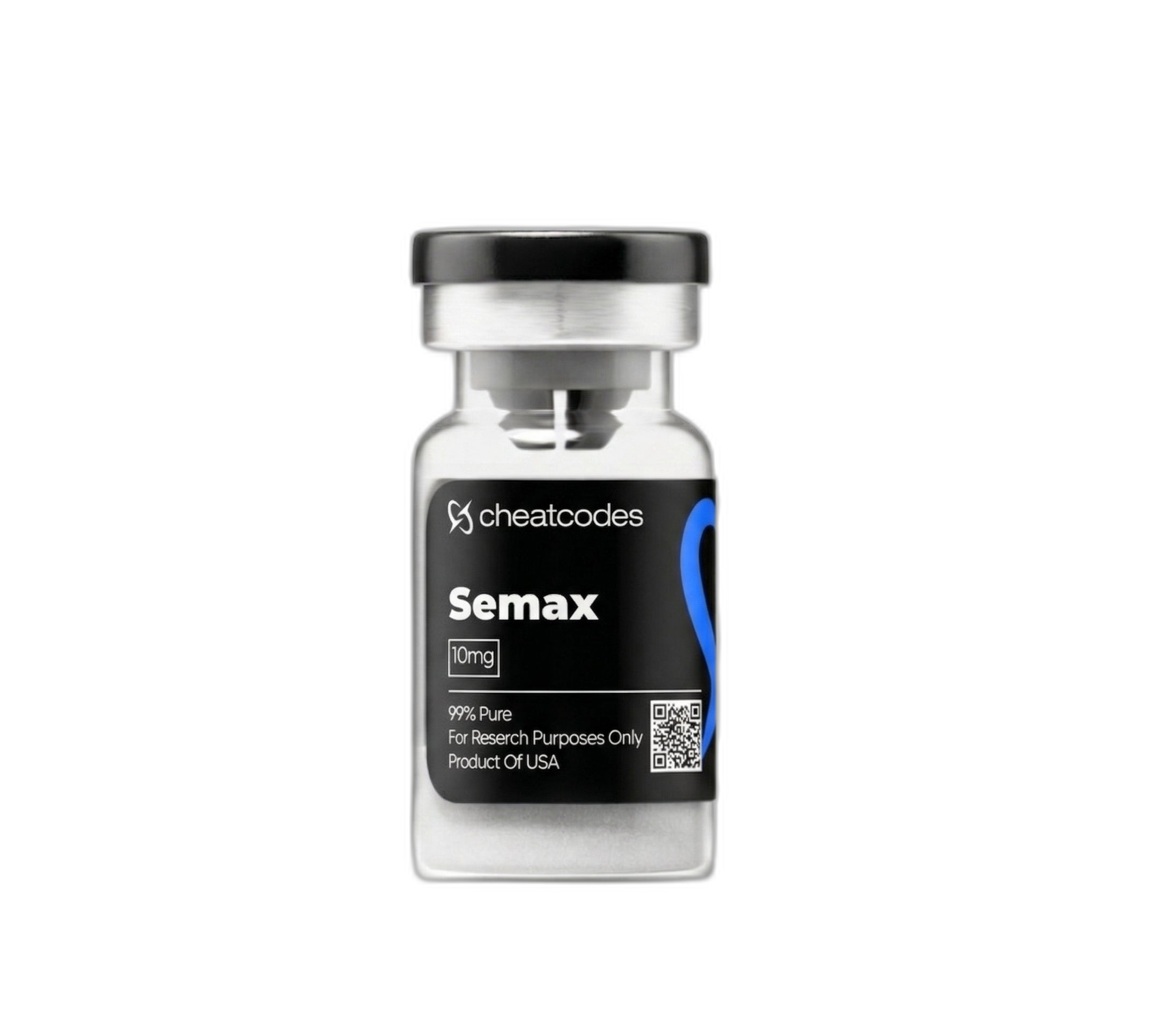
Research-grade Semax in stock
Semax · $22.99 – $59.99
All products are supplied for laboratory research use only. They are not intended for human or animal consumption, and have not been evaluated by the FDA for the diagnosis, treatment, cure, or prevention of any disease.
References
- Semax and Pro-Gly-Pro Activate the Transcription of Neurotrophins and Their Receptor Genes after Cerebral Ischemia. Cellular and Molecular Neurobiology (2010).
- Semax, An ACTH(4-10) Analogue with Nootropic Properties, Activates Dopaminergic and Serotoninergic Brain Systems in Rodents. Neurochemical Research (2005).
- Semax and selank inhibit the enkephalin-degrading enzymes from human serum. Bioorganicheskaia Khimiia (2001).