
Selank
Selank: Research Compound Overview
Selank is a synthetic heptapeptide (Thr-Lys-Pro-Arg-Pro-Gly-Pro) designed as an analog of tuftsin, an endogenous tetrapeptide derived from the heavy chain of immunoglobulin G. It extends the tuftsin sequence with a C-terminal Pro-Gly-Pro motif intended to improve metabolic stability, and it was developed at the Institute of Molecular Genetics of the Russian Academy of Sciences.
| CAS number | 129954-34-3 |
|---|---|
| Molecular formula | C33H57N11O9 |
| Molecular weight | 751.89 g/mol |
| Sequence | TKPRPGP (Thr-Lys-Pro-Arg-Pro-Gly-Pro) |
| Storage | Store lyophilized at -20 °C, desiccated, protected from light. |
Chemical identity & structure
Selank is a linear seven-residue peptide with the sequence TKPRPGP (Thr-Lys-Pro-Arg-Pro-Gly-Pro).
- CAS number: 129954-34-3 (free peptide)
- Molecular formula: C33H57N11O9
- Molecular weight: approximately 751.89 g/mol
- Length: 7 amino acids
- Registry identifiers: PubChem CID 11765600; FDA UNII TS9JR8EP1G
The N-terminal tetrapeptide Thr-Lys-Pro-Arg is the sequence of tuftsin, a fragment of the Fc region of the immunoglobulin G heavy chain. The C-terminal Pro-Gly-Pro extension was added to slow enzymatic degradation; proline-rich motifs of this type restrict backbone flexibility and are poor substrates for many common peptidases. The peptide carries two basic residues (Lys, Arg) and no acidic residues, giving it a net positive charge at neutral pH. It contains no cysteine, methionine or tryptophan, so the most common oxidation-sensitive side chains are absent. Research material is produced by solid-phase peptide synthesis and is frequently supplied as an acetate salt.
Mechanisms studied in the literature
Mechanistic work on Selank has largely come from Russian research groups and centres on the GABAergic system, peptidase inhibition and gene-expression profiling.
GABAergic signalling. Volkova et al. (Frontiers in Pharmacology, 2016) used a real-time PCR array covering 84 neurotransmission-related genes to profile the rat frontal cortex after Selank or GABA exposure. Expression changes observed at the one-hour time point correlated between the Selank and GABA groups, which the authors interpreted as partial support for a hypothesis of allosteric modulation of the GABAergic system. The study measured mRNA levels rather than receptor activity.
Cell-culture gene expression. Filatova et al. (Frontiers in Pharmacology, 2017) extended this work to IMR-32 human neuroblastoma cells, comparing Selank, GABA and olanzapine alone and in combination. Selank alone did not alter the measured GABA-related transcripts, while its combination with GABA or olanzapine changed the expression pattern relative to either compound alone.
Enkephalinase inhibition. Kost et al. (Bioorganicheskaia Khimiia, 2001) reported that Selank and the related peptide Semax inhibited enkephalin-degrading enzymes in human serum in vitro in a concentration-dependent manner, and that shorter fragments retained some inhibitory activity. This has been proposed as one route by which the peptide could influence endogenous opioid peptide levels.
Areas of published research
Published research on Selank is concentrated in the following areas:
- Neuropharmacology: rodent behavioural models of anxiety-like and stress-related behaviour, and the interaction of Selank with GABAergic and monoaminergic systems.
- Molecular neuroscience: transcriptomic studies of neurotransmission-related genes in rodent brain tissue and human neuronal cell lines.
- Peptide biochemistry: design of metabolically stabilized analogs of regulatory peptides, and the role of C-terminal Pro-Gly-Pro motifs in resistance to proteolysis.
- Immunology: because the parent tuftsin sequence is associated with phagocyte function, Selank has also been examined in studies of immune-related gene expression and cytokine profiles.
- Enzymology: inhibition of enkephalin-degrading peptidases in serum.
Selank has been investigated in clinical research, mainly in Russia. CheatCodes supplies it strictly as a research-use-only reference material for laboratory investigation and not for any other purpose.
Because much of the literature originates from a small number of collaborating institutes and is published partly in Russian-language journals, independent replication and standardized reporting of peptide source, salt form and purity are valuable. Well-characterized reference material supports this kind of reproducibility work.
Handling, reconstitution chemistry & storage
Selank is supplied as a lyophilized (freeze-dried) powder. In the dry state, short peptides of this kind are generally most stable when kept at -20 °C or below, sealed, desiccated and protected from light. Vials should be allowed to reach room temperature before opening so that atmospheric moisture does not condense on the powder, since absorbed water can accelerate hydrolysis.
As a short, basic and highly polar peptide, Selank is generally freely soluble in water and dilute aqueous buffers. The absence of methionine and cysteine makes oxidation a lesser concern than for many peptides. Deamidation-prone residues (Asn, Gln) are also absent. The multiple proline residues contribute to resistance against many exopeptidases, but solutions remain more vulnerable to degradation and microbial contamination than the dry powder.
Common laboratory practice is to prepare a concentrated stock in a suitable sterile solvent, divide it into single-use aliquots, and store the aliquots frozen to avoid repeated freeze–thaw exposure. Solutions should be protected from light, and buffer pH should be chosen with the downstream assay in mind.
Because Selank contains no aromatic residues, it has negligible absorbance at 280 nm, so UV-based concentration checks at that wavelength are not informative. Researchers commonly rely on net peptide content from the COA, amino-acid analysis, or absorbance in the far-UV peptide-bond region. Lyophilized peptide powders contain variable amounts of counter-ion and residual water, and glass or low-binding polypropylene vials help reduce adsorptive losses at low concentrations.
Quality documentation
Every CheatCodes lot of Selank is analyzed by reverse-phase HPLC for chromatographic purity and by mass spectrometry for identity confirmation, with the observed mass compared against the theoretical value for the expected sequence. The findings of that analysis are recorded on a lot-specific certificate of analysis (COA), which is published in the CheatCodes COA library and can be matched to the lot number printed on each vial.
Lot traceability matters for reproducibility. Synthetic peptides can differ between batches in purity, counter-ion content (for example acetate or trifluoroacetate), water content and the profile of minor related impurities such as deletion or truncated sequences. For a short peptide such as Selank, the acetate counter-ion can represent a meaningful fraction of the gross powder mass. Recording the lot number alongside experimental data allows a laboratory to compare runs across material batches, to investigate unexpected variation, and to report the analytical characterization of the material in methods sections. Researchers are encouraged to retain the COA with their laboratory records and to use net peptide content, rather than gross powder weight, when preparing stock solutions.
A certificate of analysis for a synthetic peptide generally identifies the compound name, lot number and test date, reports HPLC purity as a percentage of total peak area, and records the mass observed by MS against the expected value. Reviewing these fields before an experiment confirms that the material on the bench matches the material described in the laboratory record.
Frequently asked questions
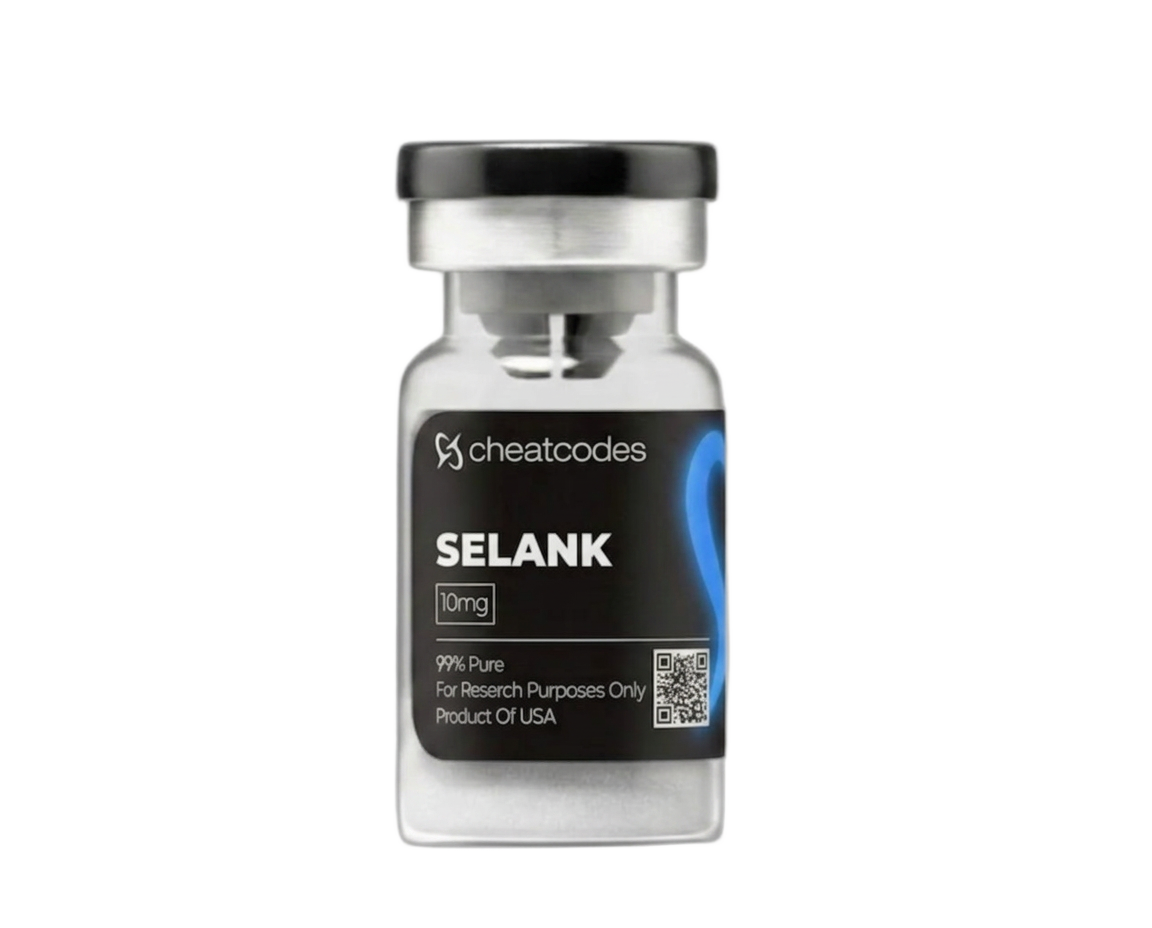
Research-grade Selank in stock
Selank · $22.99 – $49.99
All products are supplied for laboratory research use only. They are not intended for human or animal consumption, and have not been evaluated by the FDA for the diagnosis, treatment, cure, or prevention of any disease.
References
- Selank Administration Affects the Expression of Some Genes Involved in GABAergic Neurotransmission. Frontiers in Pharmacology (2016).
- GABA, Selank, and Olanzapine Affect the Expression of Genes Involved in GABAergic Neurotransmission in IMR-32 Cells. Frontiers in Pharmacology (2017).
- Semax and selank inhibit the enkephalin-degrading enzymes from human serum. Bioorganicheskaia Khimiia (2001).