
NAD+
NAD+: Research Compound Overview
Nicotinamide adenine dinucleotide (NAD+) is a dinucleotide coenzyme present in all living cells, built from an adenine nucleotide and a nicotinamide nucleotide joined through a pyrophosphate bridge. It serves as a hydride-accepting redox cofactor and as a consumed substrate for several enzyme families, which makes it one of the most widely studied small molecules in cellular metabolism research.
| CAS number | 53-84-9 |
|---|---|
| Molecular formula | C21H27N7O14P2 |
| Molecular weight | 663.43 g/mol |
| Storage | Store lyophilized at -20 °C, desiccated, protected from light. |
Chemical identity & structure
NAD+ is the oxidized form of nicotinamide adenine dinucleotide. Its two nucleotide halves, adenosine 5'-monophosphate and nicotinamide mononucleotide (NMN), are linked by a pyrophosphate (diphosphate) bond. The positively charged nicotinamide ring is the reactive centre: it accepts a hydride ion at its C4 position to form the reduced species NADH.
- CAS number: 53-84-9
- Molecular formula: C21H27N7O14P2
- Molecular weight: 663.43 g/mol
- Synonyms: nadide, beta-NAD, diphosphopyridine nucleotide (DPN)
- Class: pyridine dinucleotide coenzyme (non-peptide)
Because NAD+ is a nucleotide rather than a peptide, it has no amino-acid sequence. Commercial research material is typically supplied as the free acid or as a sodium salt, and the form affects the formula weight used in molarity calculations. Researchers should confirm the form stated on the lot COA before preparing stock solutions.
NAD+ is closely related to several other pyridine nucleotides that may appear as impurities or degradation products in research material. These include NADH (the reduced form), NADP+ and NADPH (phosphorylated at the 2' position of the adenosine ribose), nicotinamide, ADP-ribose and NMN. Because several of these species absorb in the same UV region, chromatographic separation rather than simple absorbance is used to assess purity. The beta anomer is the biologically relevant form; alpha-NAD+ is a known isomer that can be resolved by HPLC.
Mechanisms studied in the literature
The literature describes two broad roles for NAD+. The first is redox chemistry: NAD+ and NADH shuttle electrons between catabolic reactions such as glycolysis, the tricarboxylic acid pathway and fatty-acid oxidation, and complex I of the mitochondrial electron transport chain. In this role the coenzyme is interconverted but not consumed, and the cellular NAD+/NADH ratio is used as an indicator of redox state in many in-vitro studies.
The second role is as a consumed substrate. Researchers have investigated three main families of NAD+-consuming enzymes:
- Sirtuins (SIRT1–SIRT7): NAD+-dependent deacylases that remove acetyl and other acyl groups from histones and metabolic enzymes, releasing nicotinamide.
- Poly(ADP-ribose) polymerases (PARPs): enzymes that transfer ADP-ribose units onto target proteins, studied extensively in the context of DNA damage signalling.
- CD38 and CD157 (and SARM1): NAD+ glycohydrolases and cyclases that generate signalling metabolites such as cyclic ADP-ribose.
Because these enzymes consume NAD+, cells maintain the pool through biosynthetic routes: the de novo pathway from tryptophan, the Preiss-Handler pathway from nicotinic acid, and the salvage pathway, in which nicotinamide phosphoribosyltransferase (NAMPT) regenerates NMN from nicotinamide. Reviews such as Covarrubias et al. (2021) and Verdin (2015) summarize how the balance between synthesis and consumption has been examined in cell culture and animal models.
In-vitro enzyme studies commonly use NAD+ as a cofactor in dehydrogenase assays, where the formation of NADH is monitored by the increase in absorbance at 340 nm or by fluorescence. Sirtuin and PARP activity assays likewise rely on defined NAD+ concentrations, because the Michaelis constants of these enzymes for NAD+ differ and the available substrate concentration can determine which enzyme family is favoured in a given model.
Areas of published research
NAD+ appears across a wide range of research fields. Major areas include:
- Cellular bioenergetics: mitochondrial respiration, glycolytic flux and the regulation of the NAD+/NADH ratio.
- Biology of ageing: studies reporting age-associated changes in tissue NAD+ levels in rodents and other model organisms, and the enzymes thought to contribute to those changes.
- Genome maintenance: PARP-mediated DNA damage signalling and the competition between PARPs and sirtuins for a shared substrate pool.
- Neurobiology: axonal degeneration models in which SARM1 activation and NAD+ depletion have been characterized.
- Metabolic and circadian research: links between NAD+ availability, sirtuin activity and clock-gene regulation.
- Precursor pharmacology: comparative work on NAD+ precursors such as nicotinamide riboside (NR) and NMN in animal models, reviewed by Rajman, Chwalek and Sinclair (2018).
NAD+ precursors have also been investigated in clinical research, and that literature remains an active area of study.
Handling, reconstitution chemistry & storage
Lyophilized NAD+ is a white to off-white hygroscopic powder. The dry solid is most stable when kept cold, desiccated and protected from light; long-term storage at -20 °C is standard practice. Vials should be allowed to reach room temperature before opening to limit condensation, because absorbed water accelerates hydrolysis.
NAD+ is freely soluble in water and common aqueous buffers. In solution, its stability depends strongly on pH: the oxidized form is relatively stable under mildly acidic to neutral conditions but degrades in alkaline solution, where the nicotinamide-ribose glycosidic bond is cleaved. (The reduced form, NADH, shows the opposite pattern and is more stable under alkaline conditions.) Elevated temperature and repeated freeze-thaw also increase degradation. Many laboratories prepare aqueous stocks fresh, or aliquot them into single-use portions stored frozen.
Concentration of NAD+ solutions can be checked spectrophotometrically, since the adenine moiety absorbs at 260 nm. The appearance of an absorbance band near 340 nm indicates the presence of NADH, which is useful when assessing whether a stock has undergone reduction.
Quality documentation
Every CheatCodes lot of NAD+ is analyzed before release. Reversed-phase high-performance liquid chromatography (HPLC) with UV detection is used to quantify chromatographic purity as an area-percent value and to reveal related substances, truncated species or degradation products. Mass spectrometry (MS) confirms that the principal peak carries the expected molecular mass, so identity and purity are documented independently of each other.
The lot-specific Certificate of Analysis (COA) for each batch is published in the CheatCodes COA library, under the nad-plus entry. A COA typically records the lot number, test date, HPLC chromatogram and purity figure, the observed mass, and the appearance of the lyophilized material. Researchers can match the lot number printed on the vial label to the corresponding COA.
Lot traceability matters for reproducibility. Minor differences in purity, counter-ion content or residual moisture between batches can shift apparent potency in an assay, so recording the lot number alongside experimental data allows variation to be traced to its source. Many laboratories file the COA with their notebook records and cite the lot in methods sections so that other groups can reproduce the experimental conditions as closely as possible.
Frequently asked questions
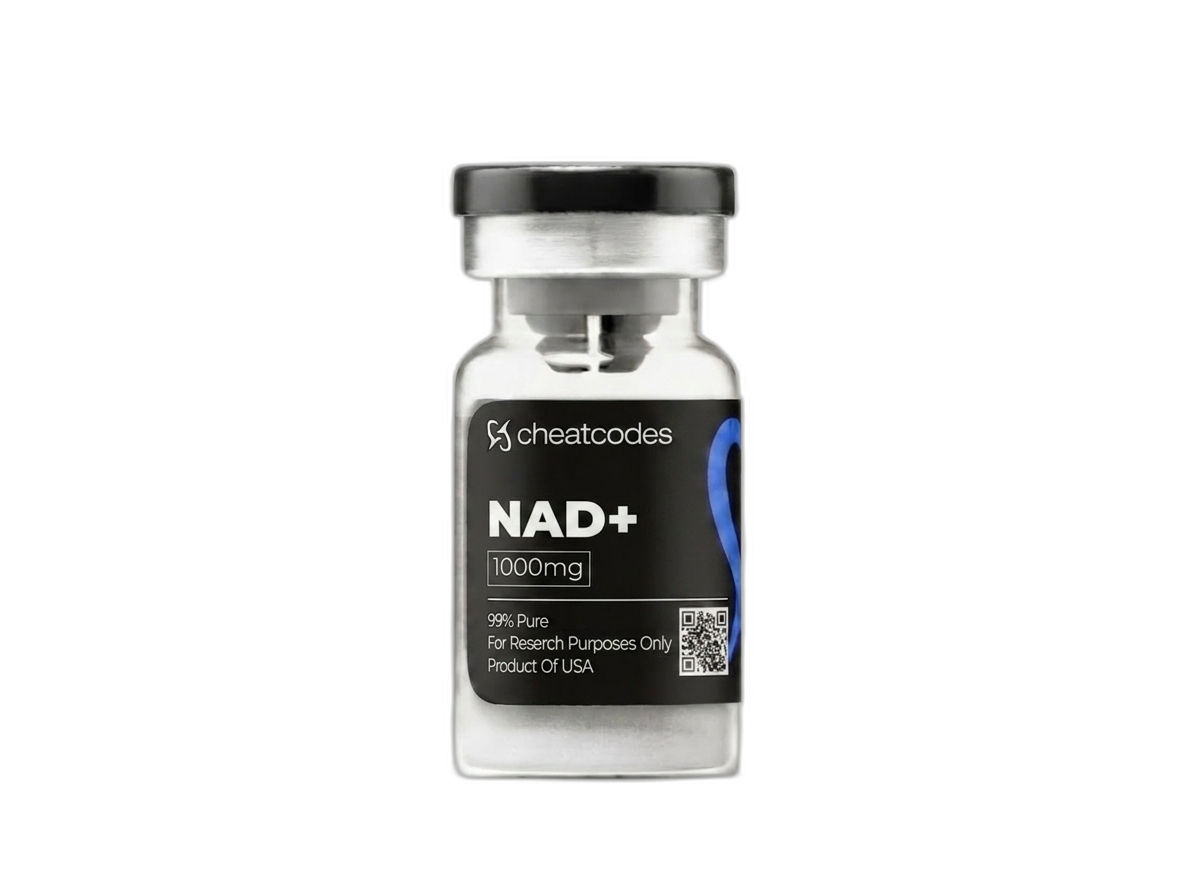
Research-grade NAD+ in stock
NAD+ · $47.99 – $60.00
All products are supplied for laboratory research use only. They are not intended for human or animal consumption, and have not been evaluated by the FDA for the diagnosis, treatment, cure, or prevention of any disease.
References
- NAD+ metabolism and its roles in cellular processes during ageing. Nature Reviews Molecular Cell Biology (2021).
- NAD+ in aging, metabolism, and neurodegeneration. Science (2015).
- Therapeutic Potential of NAD-Boosting Molecules: The In Vivo Evidence. Cell Metabolism (2018).