
MOTS-c
MOTS-c: Research Compound Overview
MOTS-c (mitochondrial open reading frame of the 12S rRNA-c) is a 16-amino-acid peptide encoded within the mitochondrial MT-RNR1 gene, first described in 2015. It belongs to the family of mitochondrial-derived peptides and is studied as a model of signalling between the mitochondrial genome and the nucleus.
| CAS number | 1627580-64-6 |
|---|---|
| Molecular formula | C101H152N28O22S2 |
| Molecular weight | 2174.6 g/mol |
| Sequence | MRWQEMGYIFYPRKLR (Met-Arg-Trp-Gln-Glu-Met-Gly-Tyr-Ile-Phe-Tyr-Pro-Arg-Lys-Leu-Arg) |
| Storage | Store lyophilized at -20 °C, desiccated, protected from light. |
Chemical identity & structure
MOTS-c is a linear 16-residue peptide with the sequence MRWQEMGYIFYPRKLR (Met-Arg-Trp-Gln-Glu-Met-Gly-Tyr-Ile-Phe-Tyr-Pro-Arg-Lys-Leu-Arg). The UniProt entry A0A0C5B5G6 lists it as "Mitochondrial-derived peptide MOTS-c", encoded by a short open reading frame within the human MT-RNR1 (12S rRNA) gene.
- CAS number: 1627580-64-6
- Molecular formula: C101H152N28O22S2
- Molecular weight: approximately 2174.6 g/mol
- Length: 16 amino acids
The sequence contains two methionine residues, which makes the peptide susceptible to oxidation to methionine sulfoxide, and a C-terminal cluster of basic residues (Arg-Lys-Leu-Arg) that gives it a net positive charge at neutral pH. Tryptophan and two tyrosines contribute aromatic character and UV absorbance useful for HPLC detection. Research material is produced by solid-phase peptide synthesis and is typically isolated as an acetate or trifluoroacetate salt.
Mechanisms studied in the literature
In the original characterization, Lee et al. (Cell Metabolism, 2015) reported that MOTS-c acts on the folate–methionine pathway and de novo purine biosynthesis in cultured cells, leading to accumulation of the intermediate AICAR and activation of AMP-activated protein kinase (AMPK). The same work examined skeletal muscle as a principal target tissue in mouse models.
Kim et al. (Cell Metabolism, 2018) reported that, under metabolic stress, MOTS-c translocates from the cytoplasm to the nucleus in an AMPK-dependent manner, where it was associated with regulation of nuclear genes, including genes containing antioxidant response elements regulated by NRF2. This work positioned MOTS-c as an example of mitochondrial-to-nuclear (retrograde) signalling.
Reynolds et al. (Nature Communications, 2021) examined endogenous MOTS-c expression in the context of exercise and studied administration of the peptide in young, middle-aged and old mouse models, with a focus on skeletal muscle metabolism and physical capacity. Review articles, such as Wan et al. (Journal of Translational Medicine, 2023), summarize additional in-vitro and animal work on cellular stress responses and metabolic regulation.
Areas of published research
Published research on MOTS-c spans several fields:
- Mitochondrial biology: mitochondrial-derived peptides as a class, and how the mitochondrial genome encodes small bioactive peptides.
- Metabolic research: AMPK signalling, glucose handling and insulin sensitivity in cell and rodent models, including diet-induced obesity models.
- Skeletal muscle physiology: muscle metabolism and the relationship between exercise and endogenous peptide expression.
- Ageing biology: age-associated changes in metabolic regulation in rodent models.
- Cellular stress signalling: nuclear translocation and transcriptional responses under oxidative and metabolic stress.
MOTS-c appears on the World Anti-Doping Agency prohibited list, which has prompted analytical chemistry work on its detection. Human data on exogenous MOTS-c remain limited; it is supplied by CheatCodes strictly as a research-use-only reference material.
Researchers working with MOTS-c often design experiments alongside related mitochondrial-derived peptides such as humanin and the small humanin-like peptides (SHLPs), which are also encoded within mitochondrial ribosomal RNA genes. Comparative studies of this family address how short open reading frames in the mitochondrial genome are translated and how their products are distributed between cellular compartments.
Handling, reconstitution chemistry & storage
MOTS-c is supplied as a lyophilized (freeze-dried) powder. In the dry state, peptides of this kind are generally most stable when kept at -20 °C or below, sealed, desiccated and protected from light. Vials should be allowed to reach room temperature before opening so that atmospheric moisture does not condense on the powder, since absorbed water can accelerate hydrolysis and aggregation.
Because the sequence contains two methionine residues, MOTS-c is susceptible to oxidation. Minimizing headspace oxygen, avoiding prolonged exposure of solutions to air, and using degassed solvents where practical help limit methionine sulfoxide formation, which appears as a +16 Da species in mass spectrometry. The basic C-terminal region generally confers good solubility in aqueous media.
Once in solution, peptides are considerably less stable than in lyophilized form. Common laboratory practice is to prepare a concentrated stock in a suitable sterile solvent, divide it into single-use aliquots, and store the aliquots frozen to avoid repeated freeze–thaw exposure. Solutions should be protected from light and from microbial contamination, and buffer pH should be selected with the peptide's isoelectric behaviour and the downstream assay in mind.
Before use in quantitative work, researchers commonly verify concentration independently, for example by UV absorbance where aromatic residues are present or by amino-acid analysis, because lyophilized peptide powders contain variable amounts of counter-ion and residual water. Glass or low-binding polypropylene vials help reduce adsorptive losses at low concentrations.
Quality documentation
Every CheatCodes lot of MOTS-c is analyzed by reverse-phase HPLC for chromatographic purity and by mass spectrometry for identity confirmation, with the observed mass compared against the theoretical value for the expected sequence. The findings of that analysis are recorded on a lot-specific certificate of analysis (COA), which is published in the CheatCodes COA library and can be matched to the lot number printed on each vial.
Lot traceability matters for reproducibility. Synthetic peptides can differ between batches in purity, counter-ion content (for example acetate or trifluoroacetate), water content and the profile of minor related impurities such as deletion or truncated sequences. Recording the lot number alongside experimental data allows a laboratory to compare runs across material batches, to investigate unexpected variation, and to report the analytical characterization of the material in methods sections. Researchers are encouraged to retain the COA with their laboratory records and to confirm that net peptide content, rather than gross powder weight, is used when preparing stock solutions.
A certificate of analysis for a synthetic peptide generally identifies the compound name, lot number and test date, reports HPLC purity as a percentage of total peak area, and records the mass observed by MS against the expected value. Reviewing these fields before an experiment confirms that the material on the bench matches the material described in the laboratory record.
Frequently asked questions
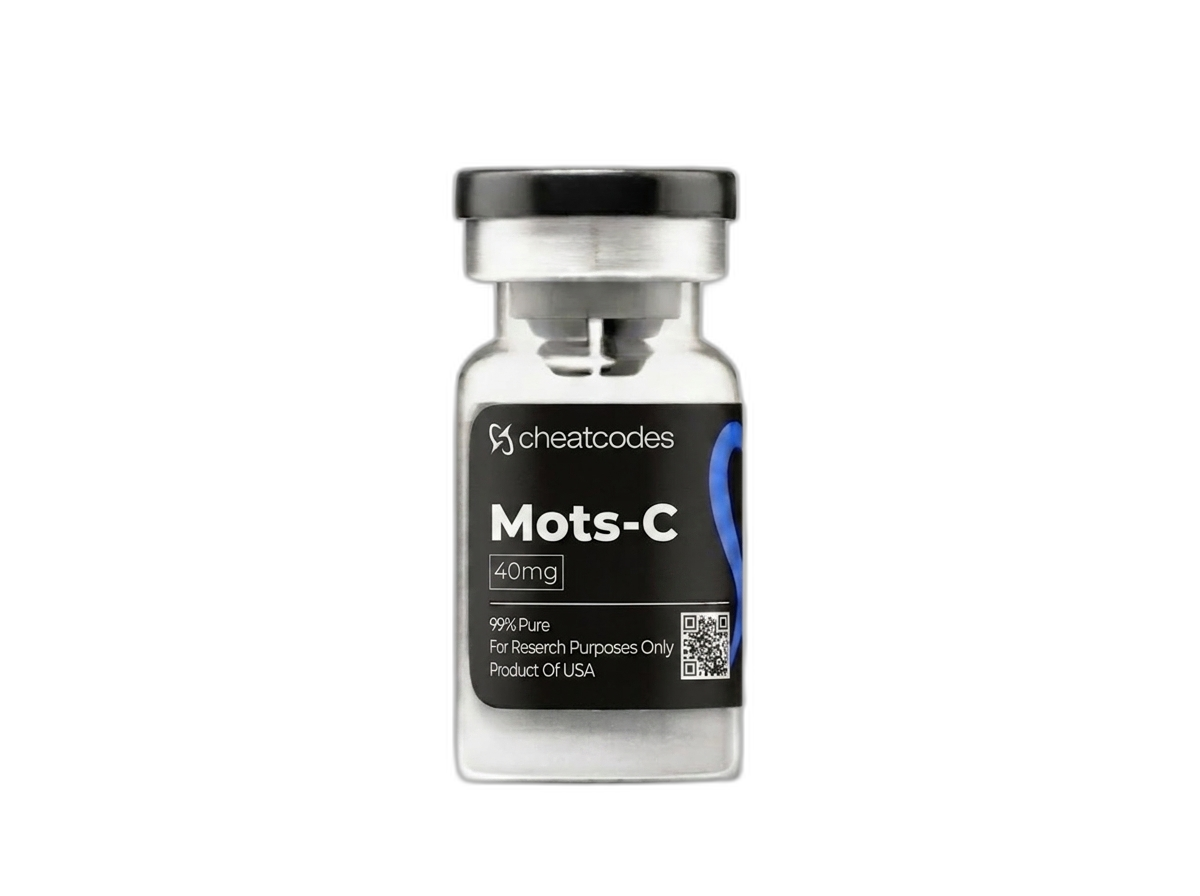
Research-grade MOTS-c in stock
MOTS-C · $35.99 – $39.99
All products are supplied for laboratory research use only. They are not intended for human or animal consumption, and have not been evaluated by the FDA for the diagnosis, treatment, cure, or prevention of any disease.
References
- The mitochondrial-derived peptide MOTS-c promotes metabolic homeostasis and reduces obesity and insulin resistance. Cell Metabolism (2015).
- The Mitochondrial-Encoded Peptide MOTS-c Translocates to the Nucleus to Regulate Nuclear Gene Expression in Response to Metabolic Stress. Cell Metabolism (2018).
- MOTS-c is an exercise-induced mitochondrial-encoded regulator of age-dependent physical decline and muscle homeostasis. Nature Communications (2021).
- Mitochondria-derived peptide MOTS-c: effects and mechanisms related to stress, metabolism and aging. Journal of Translational Medicine (2023).