
Ipamorelin
Ipamorelin: Research Compound Overview
Ipamorelin is a synthetic pentapeptide amide, Aib-His-D-2-Nal-D-Phe-Lys-NH2, developed from the GHRP-1 series of growth hormone secretagogues. It is studied as an agonist of the ghrelin receptor (growth hormone secretagogue receptor type 1a, GHS-R1a) and was described in the original pharmacology literature as the first selective growth hormone secretagogue.
| CAS number | 170851-70-4 |
|---|---|
| Molecular formula | C38H49N9O5 |
| Molecular weight | 711.9 g/mol |
| Sequence | Aib-His-D-2-Nal-D-Phe-Lys-NH2 (Aib = 2-aminoisobutyric acid; D-2-Nal = 3-(2-naphthyl)-D-alanine) |
| Storage | Store lyophilized at -20 °C, desiccated, protected from light. |
Chemical identity & structure
Ipamorelin is a five-residue peptide amide containing two non-proteinogenic amino acids and two D-amino acids:
Aib-His-D-2-Nal-D-Phe-Lys-NH2
- CAS number: 170851-70-4
- Molecular formula: C38H49N9O5
- Molecular weight: approximately 711.9 g/mol
- Length: 5 residues, linear, C-terminal amide
- Registry identifiers: PubChem CID 20754357; DrugBank DB12370; FDA UNII Y9M3S784Z6
The N-terminal residue is 2-aminoisobutyric acid (Aib, α-methylalanine), whose gem-dimethyl α-carbon restricts backbone conformation and confers resistance to aminopeptidase cleavage. Position 3 is 3-(2-naphthyl)-D-alanine (D-2-Nal), a bulky aromatic residue, followed by D-phenylalanine and a C-terminal lysine amide. The histidine imidazole and the lysine ε-amine provide ionizable groups, giving the peptide a net positive charge at neutral pH.
Ipamorelin emerged from a medicinal chemistry program based on GHRP-1 analogs lacking its central dipeptide, as described by Raun and colleagues (1998). Research material is produced by solid-phase peptide synthesis and is commonly supplied as an acetate salt. Because it contains two D-residues and an Aib residue, stereochemical purity is a relevant quality attribute, and diastereomeric impurities can usually be resolved by reverse-phase HPLC.
Mechanisms studied in the literature
Ipamorelin has been studied as an agonist of GHS-R1a, the ghrelin receptor, a class A G protein-coupled receptor that signals predominantly through Gq, phospholipase C and inositol trisphosphate (IP3)-mediated calcium mobilization. Receptor-binding and IP3-accumulation assays in GHS-R1a-expressing cell lines are the standard in vitro systems for characterizing the compound. Its receptor is distinct from the GHRH receptor targeted by GRF(1-29) analogs such as modified GRF(1-29), and the two pathways are often studied side by side.
In the original pharmacology paper, Raun and co-workers (1998) reported that ipamorelin released growth hormone from primary rat pituitary cells with potency similar to GHRP-6, and that antagonist studies pointed to a GHRP-like receptor. In anesthetized rats and conscious swine, GH release was comparable to GHRP-6. A key finding was selectivity: unlike GHRP-6 and GHRP-2, ipamorelin did not elevate ACTH or cortisol in those models, even at levels well above those needed for GH release, and it did not alter other pituitary hormones measured. This selectivity profile is the reason the compound is frequently used as a reference GHS-R1a agonist.
Subsequent preclinical studies extended this work. Johansen and colleagues (1999) examined longitudinal bone growth rate, IGF-I, IGF-binding proteins and pituitary GH content in adult female rats. Greenwood-Van Meerveld and co-workers (2012) studied ghrelin-receptor activation by ipamorelin in a rat model of postoperative gastric dysmotility, measuring gastric emptying and fundus smooth-muscle contractility in organ-bath experiments, and attributed the activity to ghrelin-receptor stimulation of cholinergic excitatory neurons.
Areas of published research
Ipamorelin appears in the following research areas:
- Ghrelin receptor pharmacology: use as a selective GHS-R1a agonist for receptor binding, signalling and selectivity studies.
- Neuroendocrinology: studies of pituitary GH secretion and the GH/IGF-1 axis in rodent and porcine models, including comparisons with GHRP-2, GHRP-6 and GHRH-receptor agonists.
- Gastrointestinal motility: preclinical models examining ghrelin-receptor signalling in gastric emptying and enteric neuromuscular function. The compound has also been investigated in clinical research in this field.
- Bone and skeletal biology: rodent studies of longitudinal bone growth parameters in relation to the GH/IGF-1 axis.
- Peptidomimetic design: as an example of how Aib and D-amino-acid substitutions are used to produce short, protease-resistant receptor ligands.
These entries describe fields of study and are not statements of any outcome.
Handling, reconstitution chemistry & storage
Lyophilized peptide powders are hygroscopic. Vials should be allowed to reach room temperature in a desiccator before opening, so that atmospheric moisture does not condense on the cold powder, and should be resealed promptly. Long-term storage of the lyophilized material at -20 °C or below, desiccated and protected from light, is the standard laboratory practice for preserving integrity; short excursions to ambient temperature during shipping are generally tolerated by dry peptide powders.
Ipamorelin is a short, basic peptide with good aqueous solubility as the acetate salt; sterile water or dilute acetic acid are common starting solvents for preparing a concentrated stock. The Aib and D-amino-acid residues make the sequence resistant to many proteases, but chemical degradation in solution is still possible. The histidine residue can be susceptible to metal-catalysed oxidation, and the naphthylalanine and phenylalanine aromatic side chains absorb UV light, so stocks should be protected from light.
Solutions are most stable at slightly acidic pH and low temperature. Divide prepared stocks into single-use aliquots, store them frozen and protected from light, and avoid repeated freeze-thaw. Thaw aliquots once and keep them cold during use.
Quality documentation
Every CheatCodes lot of ipamorelin is analyzed by reverse-phase HPLC for chromatographic purity and by mass spectrometry for identity confirmation, with the observed mass compared against the theoretical value for the expected sequence. The findings of that analysis are recorded on a lot-specific certificate of analysis (COA), which is published in the CheatCodes COA library and can be matched to the lot number printed on each vial.
Lot traceability matters for reproducibility. Synthetic peptides can differ between batches in purity, counter-ion content (for example acetate or trifluoroacetate), water content and the profile of minor related impurities such as deletion, truncated or racemized sequences. For ipamorelin, MS confirms the expected monoisotopic mass of the pentapeptide amide, while HPLC is used to resolve diastereomeric impurities that share the same mass, such as material carrying an L-residue in place of D-2-Nal or D-Phe. Recording the lot number alongside experimental data allows a laboratory to compare runs across material batches, to investigate unexpected variation, and to report the analytical characterization of the material in methods sections.
A certificate of analysis for a synthetic peptide generally identifies the compound name, lot number and test date, reports HPLC purity as a percentage of total peak area, and records the mass observed by MS against the expected value. Reviewing these fields before an experiment confirms that the material on the bench matches the material described in the laboratory record. Researchers are encouraged to retain the COA with their laboratory records and to use net peptide content, rather than gross powder weight, when preparing stock solutions.
Frequently asked questions
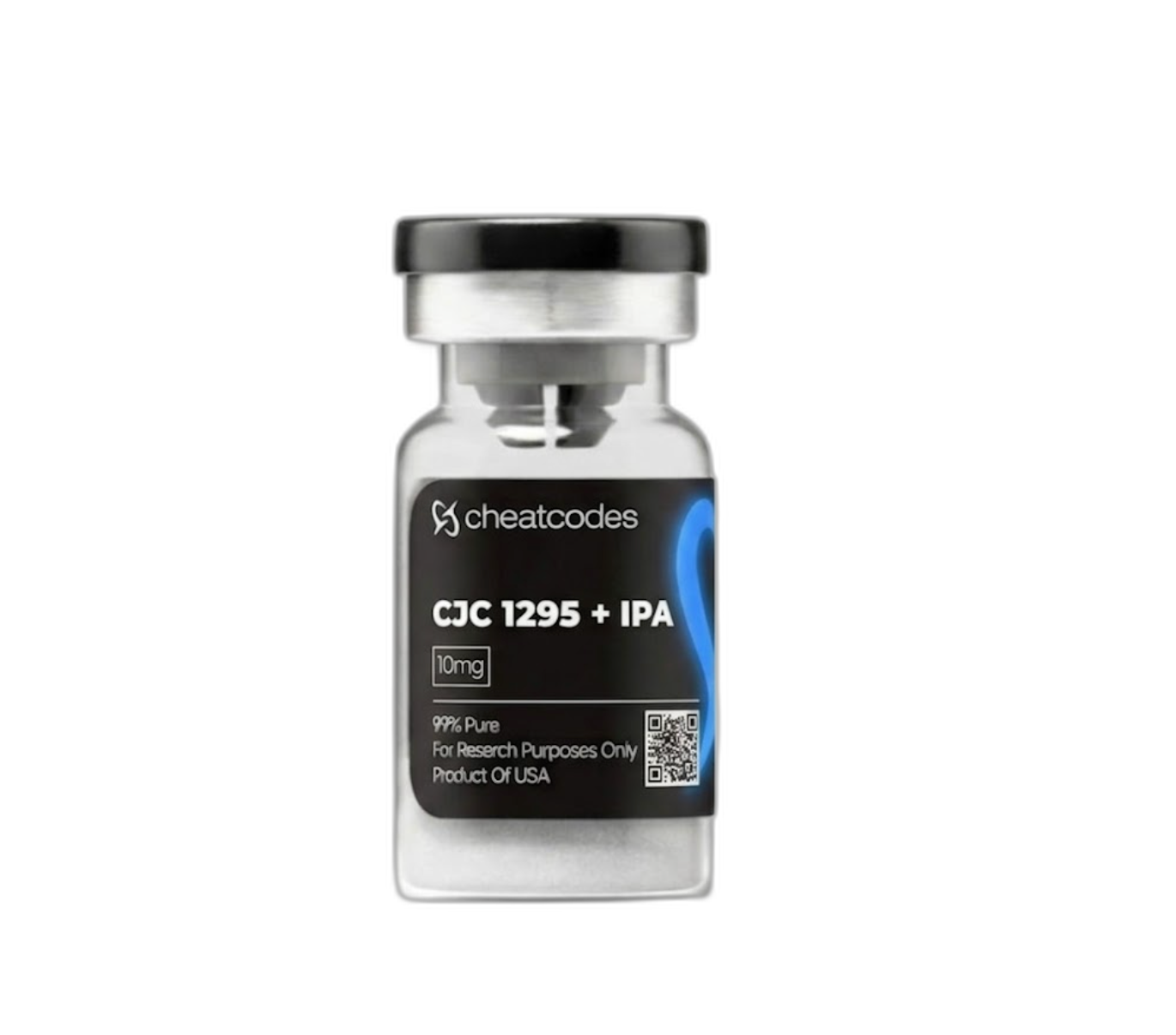
Research-grade Ipamorelin in stock
CJC 1295 + IPA · $51.99
All products are supplied for laboratory research use only. They are not intended for human or animal consumption, and have not been evaluated by the FDA for the diagnosis, treatment, cure, or prevention of any disease.
References
- Ipamorelin, the first selective growth hormone secretagogue. European Journal of Endocrinology (1998).
- Ipamorelin, a new growth-hormone-releasing peptide, induces longitudinal bone growth in rats. Growth Hormone & IGF Research (1999).
- Efficacy of ipamorelin, a ghrelin mimetic, on gastric dysmotility in a rodent model of postoperative ileus. Journal of Experimental Pharmacology (2012).