
IGF-1 LR3
IGF-1 LR3: Research Compound Overview
IGF-1 LR3, also written Long R3 IGF-I or Long [Arg3] IGF-I, is a recombinant single-chain polypeptide analog of human insulin-like growth factor 1. It is described in the literature as the 70-residue IGF-I chain carrying arginine in place of the native glutamate at position 3, extended at the amino terminus by a 13-residue peptide, giving a chain of 83 residues. The analog is studied chiefly because the modifications lower its affinity for the insulin-like growth factor binding proteins relative to native IGF-I.
| Sequence | 83 residues: a 13-residue N-terminal extension (whose residue sequence could not be confirmed against an accessible primary source and is therefore not stated) fused to the human IGF-I chain with Arg substituted for Glu at position 3. Verified parent chain, mature human IGF-I (UniProt P05019, residues 49-118, 70 aa): GPETLCGAELVDALQFVCGDRGFYFNKPTGYGSSSRRAPQTGIVDECCFRSCDLRRLEMYCAPLKPAKSA |
|---|---|
| Storage | Store lyophilized at -20 °C, desiccated, protected from light. |
Chemical identity & structure
IGF-1 LR3 is a recombinant polypeptide analog of human insulin-like growth factor 1 (IGF-I). Two structural modifications distinguish it from the native molecule: a single substitution at position 3 of the IGF-I chain, where the native glutamate is replaced by arginine, and a 13-residue extension fused to the amino terminus. The combined chain is 83 residues long.
Parent sequence. The mature human IGF-I chain is annotated in UniProt entry P05019 as residues 49 to 118 of the IGF1 precursor, a 70-residue polypeptide:
GPETLCGAELVDALQFVCGDRGFYFNKPTGYGSSSRRAPQTGIVDECCFRSCDLRRLEMYCAPLKPAKSA
Native IGF-I contains six cysteines that form three intramolecular disulfide bonds, and adopts an insulin-like tertiary fold organised into B, C, A and D regions. The analog retains this cysteine pattern, so correct oxidative folding is a defining feature of a correctly produced preparation.
Identifier summary
- Length: 83 residues (the 70-residue IGF-I chain plus a 13-residue amino-terminal extension)
- Substitution: position 3 of the IGF-I chain, Glu replaced by Arg
- Synonyms: Long R3 IGF-I, LR3 IGF-I, Long [Arg3] IGF-I, IGF-1 LR3
- CAS number: not recorded. No CAS registry number for this exact analog could be confirmed against an authoritative chemical registry during preparation of this page, so the field is left empty rather than populated with an unverified value. Numbers circulating on supplier listings have not been traced to a registry record.
- Molecular formula and molecular weight: not recorded, for the same reason. Values quoted elsewhere could not be confirmed against PubChem, CAS Common Chemistry or a peer-reviewed source, and the residue sequence of the 13-residue extension itself was not verifiable from an accessible primary source, so neither a formula nor an exact mass is asserted here.
The analog is a recombinant protein rather than a solid-phase synthetic peptide, and preparations are produced in microbial expression systems. Analytical work by Kohler and colleagues (2010) illustrates why identity confirmation matters for material of this class: the authors characterised a Long-R3-IGF-I preparation and found it carried an additional polyhistidine affinity tag, a construct difference that alters the mass of the molecule without changing its stated name.
Mechanisms studied in the literature
Native IGF-I signals through the type 1 IGF receptor (IGF-1R), a receptor tyrosine kinase, and circulates bound to a family of six insulin-like growth factor binding proteins (IGFBP-1 to IGFBP-6) that modulate its availability to the receptor. The research interest in Long R3 IGF-I lies in the second half of that system: the amino-terminal extension and the Arg3 substitution are reported to markedly lower the affinity of the molecule for the IGFBPs while leaving receptor interaction largely intact. Comparative work on IGF-I analogs has described LR3 IGF-I as having much reduced affinity for the binding proteins relative to the native growth factor (Conlon et al., 1995; Gajanandana et al., 1998).
This property makes the analog a frequently used probe in experiments designed to separate receptor-mediated events from binding-protein-mediated ones. Xi and co-workers (2004) compared IGF-I and Long-R3-IGF-I in L6 myogenic cell cultures in the presence of recombinant porcine IGFBP-3, and Pampusch and colleagues (2005) carried out an analogous comparison in porcine embryonic myoblast cultures with recombinant IGFBP-5. In both designs, the analog serves as the arm of the experiment in which binding-protein sequestration is minimised, so that the contribution of the IGFBP to the observed cellular behaviour can be examined.
The structural basis of the analog has itself been investigated. Laajoki and co-workers (2000) determined the solution structure and backbone dynamics of long-[Arg3]insulin-like growth factor-I by NMR spectroscopy, examining how the amino-terminal extension is arranged relative to the folded IGF-I core. Earlier protein-engineering work by Milner and colleagues (1995) examined how mutations in the B-domain of IGF-I influence oxidative folding and the properties of the products obtained, and Bryant and co-workers (1996) designed and characterised long-R3-IGF-I muteins investigated for resistance to pepsin digestion. Together these describe the analog as an engineered scaffold whose folding, stability and binding-protein interactions have been examined systematically.
All of the above describes what investigators have measured in vitro and in laboratory animal models. Nothing in this literature is presented here as an effect in humans.
Areas of published research
Long R3 IGF-I appears across several distinct fields of study:
- Cell culture and bioprocess science. The analog is widely used as a defined supplement in mammalian cell culture media, where its low IGFBP affinity is the reason it is selected over native IGF-I. Published culture work includes myogenic and myoblast systems (Xi et al., 2004; Pampusch et al., 2005).
- IGF/IGFBP biochemistry. Studies that dissect the regulatory role of individual binding proteins commonly use an IGFBP-insensitive analog as a comparator arm, and LR3 IGF-I is a standard choice for that purpose.
- Structural biology of growth factors. NMR studies of the solution structure and backbone dynamics of the analog, and of IGF-I variants more generally, form a body of work on how the amino terminus of this fold is organised (Laajoki et al., 2000).
- Protein engineering and proteolytic stability. Mutagenesis studies of the LR3 scaffold have examined folding yield and resistance to proteolysis (Milner et al., 1995; Bryant et al., 1996).
- Analytical chemistry and product identity. Mass-spectrometric methods for detecting and distinguishing recombinant IGF-I analogs, including tagged constructs, are an active analytical area (Kohler et al., 2010).
- Comparative animal physiology of the GH/IGF axis. Laboratory animal studies have used the analog as an experimental tool for examining the insulin-like growth factor system.
These entries identify fields of study. They are not statements of any outcome.
Handling, reconstitution chemistry & storage
Long R3 IGF-I is supplied as a lyophilized powder. Unlike short synthetic peptides, it is a folded protein with three disulfide bonds, so handling practice is aimed at preserving tertiary structure as well as covalent integrity.
Lyophilized protein powders are hygroscopic. Vials should be brought to room temperature inside a desiccator before opening, so that atmospheric moisture does not condense onto cold material, and resealed promptly. Long-term storage of the lyophilized solid at -20 °C or below, desiccated and protected from light, is standard laboratory practice; -80 °C is commonly used where extended storage is anticipated. Dry powder generally tolerates the brief ambient excursions that occur during shipping.
The molecule is typically brought into solution in dilute aqueous acid, with sterile water or a buffered solution used for subsequent dilution, reflecting the limited solubility of IGF-I-family proteins at neutral pH near their isoelectric region. Gentle swirling rather than vortexing limits foaming, since proteins of this size adsorb and denature at air-water interfaces. For dilute working solutions, a carrier protein such as bovine serum albumin is often added to reduce losses by adsorption to container surfaces.
In solution the principal chemical liabilities are disulfide scrambling and aggregation, both accelerated by elevated temperature, by extremes of pH and by repeated freezing and thawing. Dividing prepared solutions into single-use frozen aliquots, protected from light, and thawing each aliquot only once is the usual way to limit these processes. Deamidation at asparagine and glutamine residues and oxidation at methionine proceed slowly in aqueous solution and are additional reasons to avoid prolonged storage of reconstituted material at refrigerated temperature. Laboratories working with the analog typically record the solvent, concentration and storage history of each stock alongside the experimental record.
Quality documentation
Every CheatCodes lot of IGF-1 LR3 is analyzed by reverse-phase HPLC for chromatographic purity and by mass spectrometry for identity confirmation, with the observed mass compared against the value expected for the intended 83-residue construct. The findings of that analysis are recorded on a lot-specific certificate of analysis (COA), published in the CheatCodes COA library and matched to the lot number printed on each vial.
For a recombinant protein analog, identity testing carries weight beyond simple purity. The published analytical literature on this compound includes a report in which a Long-R3-IGF-I preparation was found to carry an unstated polyhistidine affinity tag (Kohler et al., 2010), a construct difference detectable by mass but invisible on a label. Mass-spectrometric confirmation is what distinguishes the intended 83-residue analog from a tagged construct, from native IGF-I, and from truncated or incorrectly folded species, while HPLC resolves aggregated and misfolded populations that share the same mass.
Lot traceability matters for reproducibility. Recombinant protein preparations can differ between batches in purity, in the proportion of correctly folded to misfolded material, in counter-ion and residual-solvent content, in water content, and in the profile of minor related species. Recording the lot number alongside experimental data allows a laboratory to compare work across material batches, to investigate unexpected variation between runs, and to describe the analytical characterization of the material in a methods section.
A certificate of analysis for a recombinant protein generally identifies the compound name, lot number and test date, reports HPLC purity as a percentage of total peak area, and records the mass observed by MS against the expected value. Reviewing these fields before beginning work confirms that the material on the bench corresponds to the material described in the laboratory record. Researchers are encouraged to retain the COA with their records and to prepare stock solutions on the basis of net protein content rather than gross powder weight.
Frequently asked questions
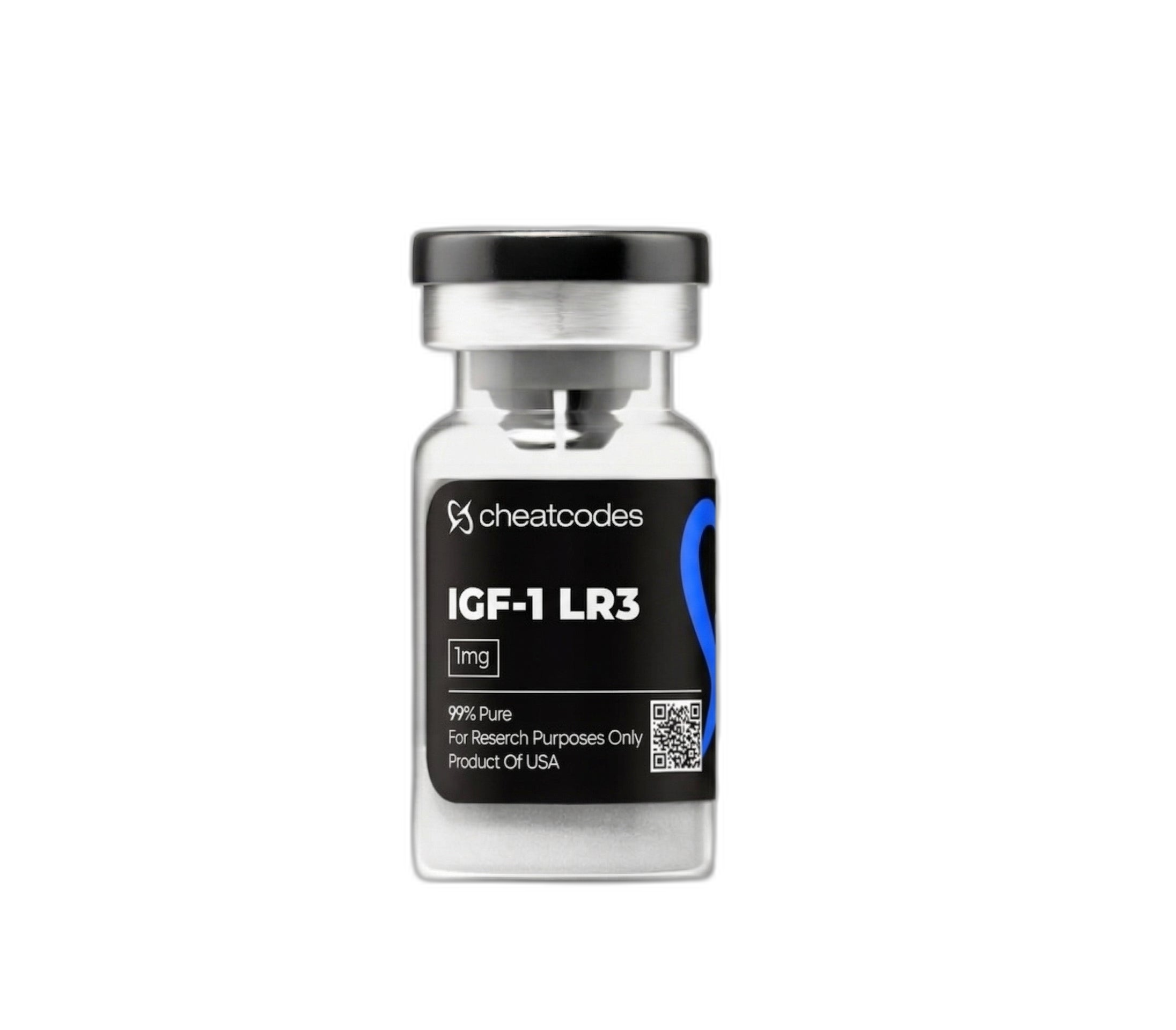
Research-grade IGF-1 LR3 in stock
IGF-1 LR3 · $63.99
All products are supplied for laboratory research use only. They are not intended for human or animal consumption, and have not been evaluated by the FDA for the diagnosis, treatment, cure, or prevention of any disease.
References
- Solution structure and backbone dynamics of long-[Arg(3)]insulin-like growth factor-I. Journal of Biological Chemistry (2000).
- Mutations in the B-domain of insulin-like growth factor-I influence the oxidative folding to yield products with modified biological properties. Biochemical Journal (1995).
- Design and characterisation of long-R3-insulin-like growth factor-I muteins which show resistance to pepsin digestion. Growth Factors (1996).
- Effect of recombinant porcine IGFBP-3 on IGF-I and long-R3-IGF-I-stimulated proliferation and differentiation of L6 myogenic cells. Journal of Cellular Physiology (2004).
- Production of recombinant porcine IGF-binding protein-5 and its effect on proliferation of porcine embryonic myoblast cultures in the presence and absence of IGF-I and Long-R3-IGF-I. Journal of Endocrinology (2005).
- Detection of His-tagged Long-R3-IGF-I in a black market product. Growth Hormone & IGF Research (2010).