
GHK-Cu
GHK-Cu: Research Compound Overview
GHK-Cu is the copper(II) complex of the tripeptide glycyl-L-histidyl-L-lysine (GHK), a peptide first isolated from human plasma in the 1970s. The tripeptide binds Cu(II) with high affinity, and the complex has been studied extensively as a model of peptide-mediated copper transport and extracellular matrix regulation.
| CAS number | 89030-95-5 |
|---|---|
| Molecular formula | C14H22CuN6O4 |
| Molecular weight | 401.91 g/mol |
| Sequence | Gly-His-Lys (GHK), Cu(II) complex |
| Storage | Store lyophilized at -20 °C, desiccated, protected from light. |
Chemical identity & structure
GHK is a linear tripeptide with the sequence Gly-His-Lys. It binds a single copper(II) ion through the nitrogen of the glycine amino terminus, the deprotonated amide nitrogen of the Gly-His peptide bond, and an imidazole nitrogen of the histidine side chain. Crystallographic and solution studies, including Hureau et al. (2011), have characterized this coordination geometry and its influence on the redox behaviour of the bound copper.
- CAS number: 89030-95-5 (copper complex); 49557-75-7 (free GHK peptide)
- Molecular formula: C14H22CuN6O4 (copper complex)
- Molecular weight: approximately 401.91 g/mol (copper complex, anhydrous)
- Sequence: Gly-His-Lys (GHK), complexed with Cu(II)
- Synonyms: copper tripeptide-1, copper peptide GHK-Cu, glycyl-L-histidyl-L-lysine copper(II)
Supplier listings for GHK-Cu report slightly different formula weights depending on hydration state and counter-ions (for example acetate or trifluoroacetate). The lot COA states the form supplied and should be used for molarity calculations. The complex has a characteristic blue colour.
The free GHK peptide and its copper complex can interconvert in solution depending on copper availability, pH and the presence of competing ligands. For this reason, some laboratories use the free peptide with defined copper salts when they need to control the metal-to-peptide ratio, while others use the preformed complex. Analogues described in the literature include GHK with D-amino-acid substitutions and lipidated derivatives such as palmitoyl-GHK, which differ in solubility and stability.
Mechanisms studied in the literature
Early work by Pickart and colleagues identified GHK as a plasma factor that influenced the behaviour of cultured liver cells. Pickart et al. (1980) reported that the tripeptide forms complexes with copper(II) and increases copper uptake into cultured hepatoma cells, which led to the hypothesis that GHK acts as a copper transport factor.
Subsequent in-vitro and preclinical studies examined effects on connective tissue biology:
- Collagen synthesis: Maquart et al. (1988) reported stimulation of collagen synthesis in fibroblast cultures exposed to the GHK-Cu complex.
- Extracellular matrix turnover: later studies investigated glycosaminoglycan and proteoglycan synthesis and the expression of matrix metalloproteinases and their tissue inhibitors.
- Gene expression profiling: Pickart and Margolina (2018) analyzed Broad Institute Connectivity Map data and reported that GHK is associated with altered expression of a large number of genes, including genes linked to tissue remodeling, antioxidant responses and the ubiquitin-proteasome system.
Because GHK binds copper so tightly, researchers often discuss whether observed activity reflects copper delivery, the peptide itself, or both. Pickart and Margolina note that copper binding alone does not appear to account for all of the gene-expression effects they describe, and this remains a point of investigation.
Areas of published research
GHK-Cu is studied in several research areas:
- Bioinorganic chemistry: copper(II) coordination, binding constants and redox properties of Cu-peptide complexes.
- Extracellular matrix biology: collagen, elastin and glycosaminoglycan synthesis and matrix remodeling in fibroblast culture.
- Dermatological and cosmetic science: formulation chemistry and skin-model studies, reviewed by Pickart, Vasquez-Soltero and Margolina (2015).
- Tissue repair models: preclinical wound repair studies in animal models.
- Transcriptomics: connectivity-map and gene-expression analyses of GHK.
- Biomaterials: incorporation of GHK and GHK-Cu into scaffolds, hydrogels and conjugates.
Topical formulations containing copper peptides have also been investigated in clinical research in dermatology.
GHK has been detected in human plasma, saliva and urine, and several reviews discuss reported differences in plasma concentration between younger and older donors. These observations are descriptive and come from measurement studies; they form part of the background for the research areas listed above rather than evidence of any outcome.
Handling, reconstitution chemistry & storage
Lyophilized GHK-Cu is a blue to blue-violet powder. As with most short peptides, the dry material is most stable when stored cold, sealed, desiccated and protected from light; -20 °C is recommended for long-term storage. Allow the vial to reach room temperature before opening to prevent condensation.
GHK-Cu is readily soluble in water. The stability of the complex in solution depends on pH: the copper-peptide coordination described above forms under near-neutral conditions, while strongly acidic conditions protonate the coordinating nitrogens and favour release of free Cu(II). Strong chelators such as EDTA compete for copper and will strip it from the peptide, and reducing agents can reduce Cu(II) to Cu(I), so buffer components should be chosen with this in mind. Phosphate buffers at high concentration may also interact with free copper.
Solutions should be protected from light and from prolonged exposure to elevated temperature. Many laboratories aliquot reconstituted material and store aliquots frozen to avoid repeated freeze-thaw. A visible shift in colour can indicate a change in the copper coordination environment.
Quality documentation
Every CheatCodes lot of GHK-Cu is analyzed before release. Reversed-phase high-performance liquid chromatography (HPLC) with UV detection is used to quantify chromatographic purity as an area-percent value and to reveal related substances, truncated species or degradation products. Mass spectrometry (MS) confirms that the principal peak carries the expected molecular mass, so identity and purity are documented independently of each other.
The lot-specific Certificate of Analysis (COA) for each batch is published in the CheatCodes COA library, under the ghk-cu entry. A COA typically records the lot number, test date, HPLC chromatogram and purity figure, the observed mass, and the appearance of the lyophilized material. Researchers can match the lot number printed on the vial label to the corresponding COA.
Lot traceability matters for reproducibility. Minor differences in purity, counter-ion content or residual moisture between batches can shift apparent potency in an assay, so recording the lot number alongside experimental data allows variation to be traced to its source. Many laboratories file the COA with their notebook records and cite the lot in methods sections so that other groups can reproduce the experimental conditions as closely as possible.
For a metal-peptide complex such as GHK-Cu, documentation of identity is especially useful, because the free peptide and the copper complex have different masses and different chromatographic behaviour.
Frequently asked questions
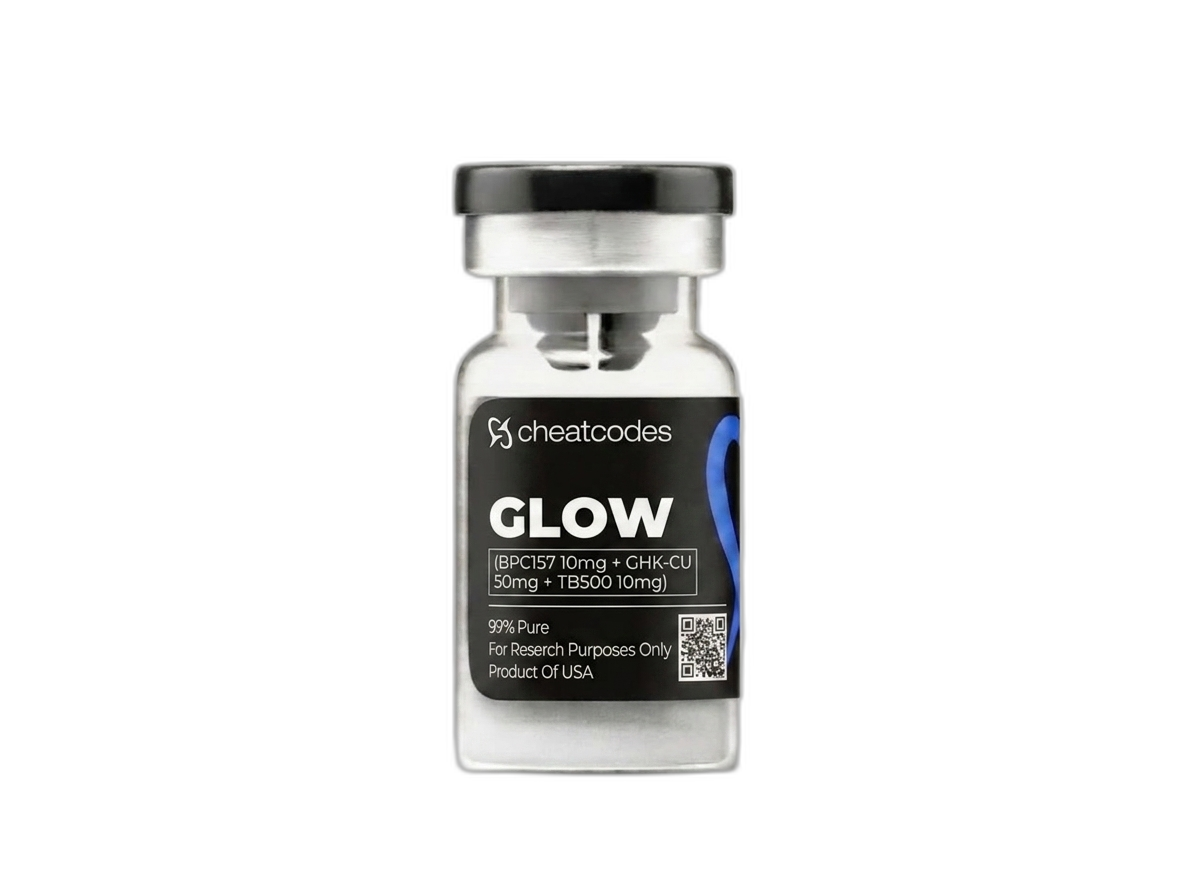
Research-grade GHK-Cu in stock
GHK-Cu · $24.99 – $44.99
All products are supplied for laboratory research use only. They are not intended for human or animal consumption, and have not been evaluated by the FDA for the diagnosis, treatment, cure, or prevention of any disease.
References
- Growth-modulating plasma tripeptide may function by facilitating copper uptake into cells. Nature (1980).
- Stimulation of collagen synthesis in fibroblast cultures by the tripeptide-copper complex glycyl-L-histidyl-L-lysine-Cu2+. FEBS Letters (1988).
- X-ray and Solution Structures of Cu(II)GHK and Cu(II)DAHK Complexes: Influence on Their Redox Properties. Chemistry - A European Journal (2011).
- GHK Peptide as a Natural Modulator of Multiple Cellular Pathways in Skin Regeneration. BioMed Research International (2015).
- Regenerative and Protective Actions of the GHK-Cu Peptide in the Light of the New Gene Data. International Journal of Molecular Sciences (2018).