
CJC-1295 (no DAC)
CJC-1295 (no DAC): Research Compound Overview
CJC-1295 without DAC, also known as modified GRF(1-29) or Mod GRF(1-29), is a synthetic 29-residue analog of the N-terminal active region of human growth hormone-releasing hormone. It carries four amino-acid substitutions (D-Ala2, Gln8, Ala15, Leu27) relative to GRF(1-29)-NH2 and, unlike CJC-1295 with DAC, has no maleimido drug affinity complex for albumin conjugation.
| Molecular formula | C152H252N44O42 |
|---|---|
| Molecular weight | 3367.9 g/mol |
| Sequence | Y-(D-Ala)-DAIFTQSYRKVLAQLSARKLLQDILSR-NH2 (Tyr-D-Ala-Asp-Ala-Ile-Phe-Thr-Gln-Ser-Tyr-Arg-Lys-Val-Leu-Ala-Gln-Leu-Ser-Ala-Arg-Lys-Leu-Leu-Gln-Asp-Ile-Leu-Ser-Arg-NH2) |
| Storage | Store lyophilized at -20 °C, desiccated, protected from light. |
Chemical identity & structure
CJC-1295 without DAC is a linear 29-amino-acid peptide amide derived from GRF(1-29)-NH2 (the sequence of sermorelin), the shortest fragment of human GHRH that retains full receptor activity:
Y-(D-Ala)-DAIFTQSYRKVLAQLSARKLLQDILSR-NH2
- Molecular formula: C152H252N44O42 (free base)
- Molecular weight: approximately 3367.9 g/mol
- Length: 29 amino acids, linear, C-terminal amide
- Synonyms: Modified GRF (1-29), Mod GRF (1-29), tetrasubstituted GRF(1-29), CJC-1295 no DAC
- CAS number: no CAS registry number could be verified for this exact sequence from an authoritative registry; numbers circulating online often belong to CJC-1295 with DAC or to other GRF analogs.
Relative to GRF(1-29)-NH2, four positions are substituted:
- Position 2: L-Ala → D-Ala. The D-configuration at position 2 is intended to resist N-terminal dipeptidyl peptidase cleavage of the Tyr1-Ala2 bond.
- Position 8: Asn → Gln. Removes an asparagine prone to deamidation and rearrangement.
- Position 15: Gly → Ala. Increases helical propensity in the central region of the peptide.
- Position 27: Met → Leu. Removes the oxidation-sensitive methionine.
The name "CJC-1295" originally referred to the same substituted backbone carrying an additional C-terminal lysine linked to a maleimidopropionic acid group (the drug affinity complex, DAC), which reacts with circulating albumin. The no-DAC peptide described here lacks that lysine-maleimide extension and is therefore a different chemical entity with a different formula and mass.
Mechanisms studied in the literature
Like other GRF(1-29) analogs, modified GRF(1-29) is studied as an agonist of the growth hormone-releasing hormone receptor (GHRHR), a class B G protein-coupled receptor on anterior pituitary somatotrophs that signals through Gs, adenylyl cyclase and cAMP. Pituitary cell cultures and GHRHR-expressing cell lines are the usual in vitro systems for characterizing this activity.
The substitutions in this analog are best understood against the stability literature for native GHRH. Frohman and colleagues (1986) showed that native GHRH(1-44)-NH2 is rapidly cleaved in plasma by a dipeptidylaminopeptidase at the N-terminus, producing GHRH(3-44)-NH2, which retains less than one-thousandth of the parent activity. The D-Ala2 substitution addresses this cleavage site, while the Gln8, Ala15 and Leu27 substitutions address deamidation, conformational and oxidation liabilities.
Work on the DAC version provides context for the backbone. Jetté and co-workers (2005) prepared maleimido derivatives of hGRF(1-29), conjugated them to albumin, and reported greater resistance to DPP-IV and activity in cultured rat anterior pituitary cells, identifying CJC-1295 as the lead conjugate. CJC-1295 with DAC was later investigated in clinical research (Teichman et al., 2006). Those studies concern the albumin-binding construct; the no-DAC peptide does not bind albumin covalently and is studied as a shorter-lived GRF(1-29) analog.
Areas of published research
Modified GRF(1-29) appears in several research areas:
- Structure-activity studies of GHRH analogs: comparison of single and combined substitutions in the GRF(1-29) scaffold, including D-amino-acid, helix-stabilizing and oxidation-resistant replacements.
- Peptide stability chemistry: the analog is a common example of protecting a peptide hormone against DPP-IV-type N-terminal cleavage by stereochemical substitution rather than by N-acylation or albumin conjugation.
- Pituitary and neuroendocrine physiology: use of GHRH-receptor agonists as tools for studying somatotroph signalling, pulsatile GH secretion and the GH/IGF-1 axis in animal and cell models.
- Comparative ligand pharmacology: studies that compare GHRH-receptor agonists with ghrelin-receptor (GHS-R1a) agonists such as ipamorelin, which act through a separate receptor.
These entries describe fields of study and are not statements of any outcome.
Handling, reconstitution chemistry & storage
Lyophilized peptide powders are hygroscopic. Vials should be allowed to reach room temperature in a desiccator before opening, so that atmospheric moisture does not condense on the cold powder, and should be resealed promptly. Long-term storage of the lyophilized material at -20 °C or below, desiccated and protected from light, is the standard laboratory practice for preserving integrity; short excursions to ambient temperature during shipping are generally tolerated by dry peptide powders.
The sequence carries three arginines and two lysines and a net positive charge at neutral pH, which generally supports solubility in water or dilute aqueous acid. Sterile water or dilute acetic acid are common starting solvents for a concentrated stock. Gentle swirling rather than vigorous agitation limits foaming and surface-induced aggregation, which can be relevant for amphipathic, helix-forming peptides of this length.
Because Met27 has been replaced by leucine, the molecule lacks the methionine oxidation pathway seen in native GRF(1-29); the remaining asparagine-free sequence also reduces deamidation liability. Aspartate residues (Asp3, Asp25) can still undergo slow isomerization in solution, especially at elevated temperature. Prepared solutions should be divided into single-use aliquots, stored frozen and protected from light, and thawed only once.
Quality documentation
Every CheatCodes lot of CJC-1295 (no DAC) is analyzed by reverse-phase HPLC for chromatographic purity and by mass spectrometry for identity confirmation, with the observed mass compared against the theoretical value for the expected sequence. The findings of that analysis are recorded on a lot-specific certificate of analysis (COA), which is published in the CheatCodes COA library and can be matched to the lot number printed on each vial.
Lot traceability matters for reproducibility. Synthetic peptides can differ between batches in purity, counter-ion content (for example acetate or trifluoroacetate), water content and the profile of minor related impurities such as deletion, truncated or racemized sequences. For this compound, MS identity testing also distinguishes the no-DAC peptide (about 3367.9 g/mol) from CJC-1295 with DAC, which is substantially heavier because of its additional lysine-maleimidopropionyl extension, and HPLC can resolve the L-Ala2 diastereomer if present. Recording the lot number alongside experimental data allows a laboratory to compare runs across material batches, to investigate unexpected variation, and to report the analytical characterization of the material in methods sections.
A certificate of analysis for a synthetic peptide generally identifies the compound name, lot number and test date, reports HPLC purity as a percentage of total peak area, and records the mass observed by MS against the expected value. Reviewing these fields before an experiment confirms that the material on the bench matches the material described in the laboratory record. Researchers are encouraged to retain the COA with their laboratory records and to use net peptide content, rather than gross powder weight, when preparing stock solutions.
Frequently asked questions
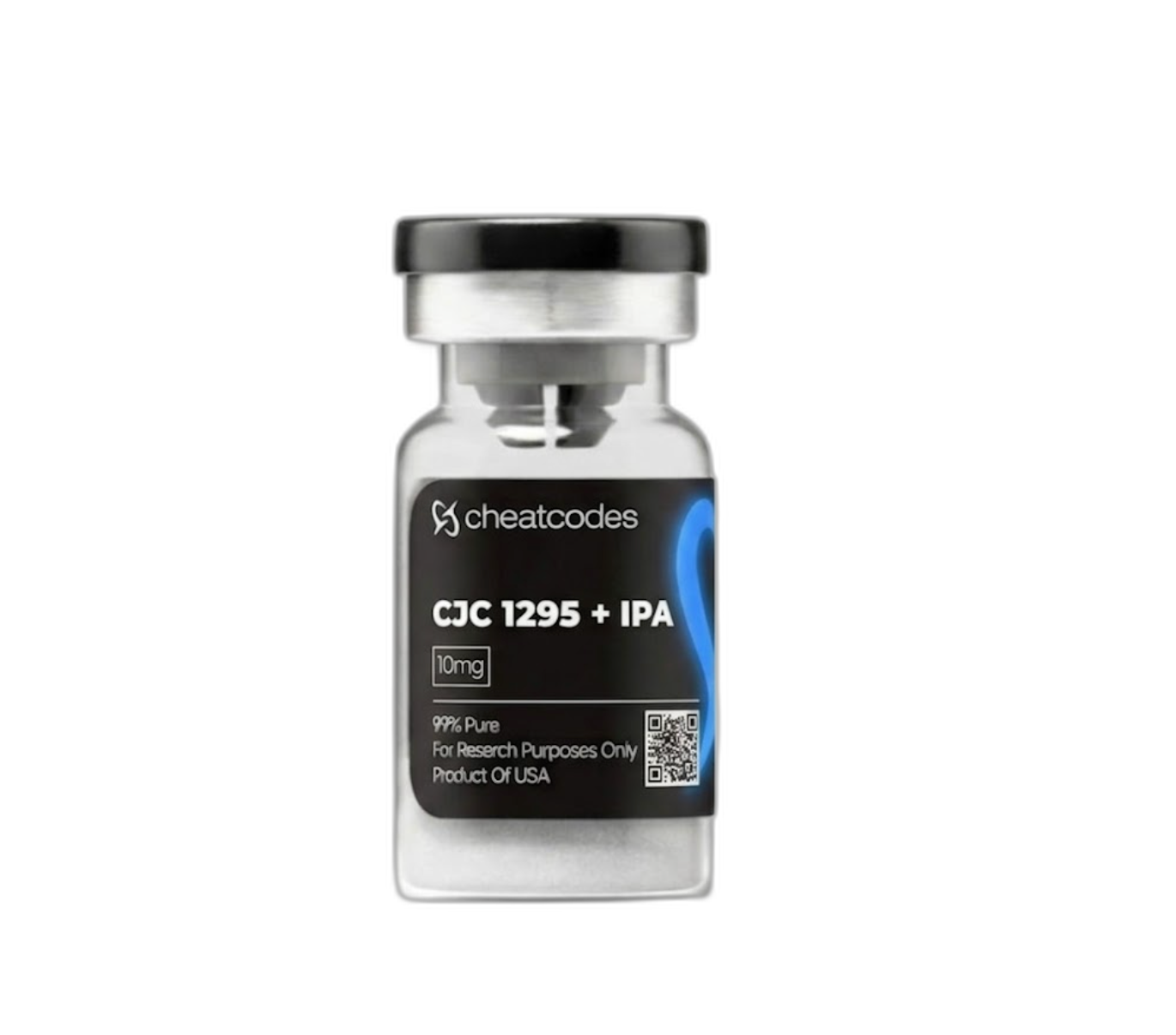
Research-grade CJC-1295 (no DAC) in stock
CJC-1295 (no DAC) · $56.99
All products are supplied for laboratory research use only. They are not intended for human or animal consumption, and have not been evaluated by the FDA for the diagnosis, treatment, cure, or prevention of any disease.
References
- Rapid enzymatic degradation of growth hormone-releasing hormone by plasma in vitro and in vivo to a biologically inactive product cleaved at the NH2 terminus. Journal of Clinical Investigation (1986).
- Human growth hormone-releasing factor (hGRF)1-29-albumin bioconjugates activate the GRF receptor on the anterior pituitary in rats: identification of CJC-1295 as a long-lasting GRF analog. Endocrinology (2005).
- Prolonged stimulation of growth hormone (GH) and insulin-like growth factor I secretion by CJC-1295, a long-acting analog of GH-releasing hormone, in healthy adults. Journal of Clinical Endocrinology & Metabolism (2006).